Hardware matrix — every machine fak has been profiled on
The point of this page:
fak’s correctness and serving claims are not from one lucky box. The same pure-Go kernel — same bit-exact gates — has been run and benchmarked across four distinct hardware platforms spanning two CPU ISAs (arm64 + x86_64), three CPU vendors (Apple · AMD · Intel), four GPU backends (Apple Metal · AMD Vulkan · NVIDIA CUDA Ada and Ampere), and four OS targets (macOS · Windows · WSL2 Linux · Linux). Portability across that spread is a result — a kernel that owns the KV cache as its own object has to prove it stays correct on every one.
Every number on this page traces to a committed artifact via the single source of
truth, fak/BENCHMARK-AUTHORITY.md. This page is the
rollup — the at-a-glance “how serious is this” view — not a new claim. Where a number
appears here it carries a pointer to the doc + commit that owns it.
Lineage: rolled up 2026-06-21 · fak v0.30.0 · against BENCHMARK-AUTHORITY +
MODEL-LADDER-VS-SOTA-2026-06-21 + the per-platform results docs linked below.
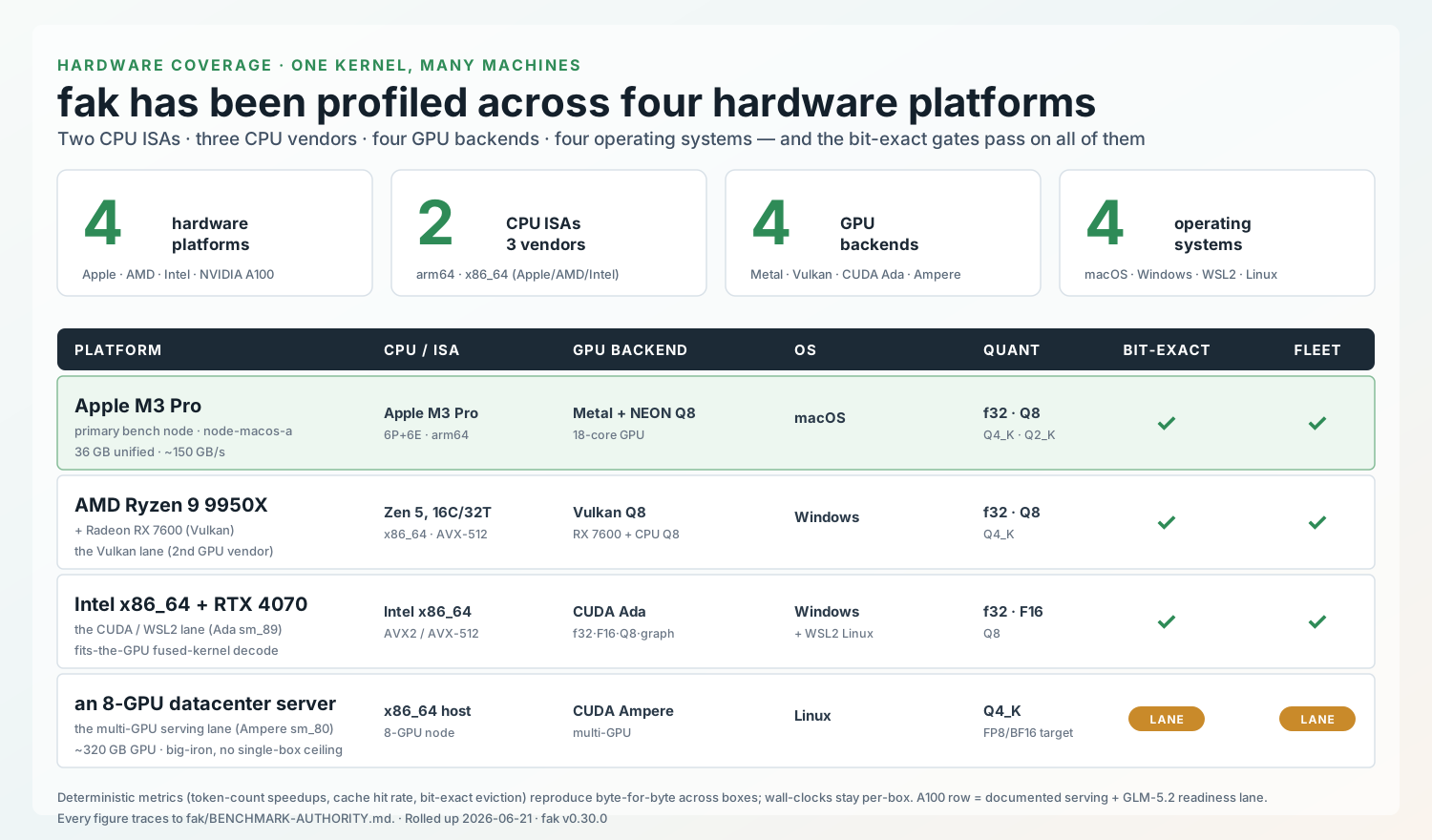
The coverage matrix
| Platform | CPU / ISA | GPU backend | OS | Quant coverage | What’s proven here |
|---|---|---|---|---|---|
| Apple M3 Pro (primary bench node) | Apple M3 Pro 6P+6E, arm64 | 18-core Metal + NEON Q8 | macOS | f32 · Q8_0 · Q4_K · Q2_K | Full model ladder, the agent-fleet value stack, the pure-kernel latency stack, Qwen3.6-27B end-to-end in fak’s own engine |
| AMD Ryzen 9 9950X + Radeon RX 7600 | AMD Zen 5, 16C/32T, x86_64, AVX-512 | Vulkan Q8 (RX 7600) + CPU Q8 | Windows | f32 · Q8_0 · Q4_K | Q8-on-GPU throughput, the GPU/CPU crossover, 3/3 live agent surfaces on Qwen3.6-27B |
| Intel x86_64 + NVIDIA RTX 4070 | Intel, x86_64, AVX2/AVX-512 | CUDA (Ada, sm_89): f32 · F16 · Q8 · graph | Windows + WSL2 Linux | f32 · F16 · Q8_0 | In-kernel CUDA decode at llama.cpp parity, batched decode curve, cross-platform bit-exact determinism vs the Mac |
| an 8-GPU datacenter server (serving lane) | x86_64 host | CUDA (Ampere, sm_80), multi-GPU | Linux | Q4_K · (FP8/BF16 target) | The multi-GPU serving + GLM-5.2 readiness lane — big-iron, where single-box ceilings stop binding |
| Raspberry Pi 5 / Jetson Orin (arm64 edge — target, not yet witnessed) | arm64 (Cortex-A76 / Arm Cortex-A78AE), small SBC | CPU NEON Q4 · (Jetson CUDA target) | Linux | Q4_K · Q2_K (target) | Planned witness, nothing measured yet — the arm64 small-SBC edge rung; closes the bottom of the deployment-substrate axis. No Pi 5 / Jetson Orin tok/s has been collected — this row is a pending future witness, not a result |
Pending 5th row. The arm64 small-SBC edge row above is a target, not a witnessed platform — the four rows below it carry measured artifacts, this one is open work (the issue is to go witness it). It is listed here so the coverage axis shows the rung that still needs collecting; no number is claimed for it.
Reading the spread: the deterministic results (token-count speedups, cache hit rate, bit-exact eviction) are hardware-independent by construction and reproduce byte-for-byte across these boxes. The wall-clock numbers are per-box and stay labeled as such. The fact that the same kernel binary’s correctness gates pass on Metal, Vulkan, and two CUDA generations is the portability claim this matrix exists to make visible.
Support-maturity matrix — generated from the scorecard
The coverage table above is the physical-hardware spread (which boxes the kernel was
profiled on). This second matrix is the support-maturity view: every model family ×
backend cell and the rung it sits at, generated from the kernel’s own grid
(internal/covmatrix) and folded by the support-maturity scorecard
(internal/supportmaturityscore) — so no cell here is hand-typed. Regenerate it with
fak support-maturity-scorecard --write-doc; a stale cell reds
fak support-maturity-scorecard --check-doc (run in CI by the cmd/fak freshness test), the
same honesty fence the other scorecards ride. It is the rollup view of epic
#1243’s maturity instrument; the
living authority row is in
BENCHMARK-AUTHORITY.md.
Grade A - value 1 - legacy score 100 - support_maturity_debt 0 (sum(target-current) rungs over 0 cell(s) below their declared target) - 32/56 cells SUPPORTED
Generated from internal/covmatrix (the kernel’s own model x backend grid) and folded by internal/supportmaturityscore – not hand-typed. Each cell is the support rung of one (model family x backend): SUPPORTED (runs with a CI witness on this path), PROOF-PATH-ONLY (runs on the cpu scalar path, no CI numeric oracle), FENCED (the accelerated path refuses honestly rather than diverge), UNDEFINED (a silently-reachable wrong result – the debt this view exists to catch). The headline support_maturity_debt is the declared-TARGET shortfall (#1247): each cell declares the rung its regime honestly expects (a non-PreNorm accelerated cell targets its FENCE, not SUPPORTED), and debt = sum(target - current) over cells below target – so an honestly-fenced cell is 0, not debt.
| Model family | Topology | cpu | cuda | metal | vulkan |
|---|---|---|---|---|---|
| Llama | PreNorm | SUPPORTED | SUPPORTED | SUPPORTED | SUPPORTED |
| Qwen2/3.x | PreNorm | SUPPORTED | SUPPORTED | SUPPORTED | SUPPORTED |
| GPT-NeoX | ParallelResidual | SUPPORTED | FENCED | FENCED | FENCED |
| Falcon | ParallelResidual | SUPPORTED | FENCED | FENCED | FENCED |
| MPT | PreNorm | SUPPORTED | SUPPORTED | SUPPORTED | SUPPORTED |
| StableLM | PreNorm | SUPPORTED | SUPPORTED | SUPPORTED | SUPPORTED |
| OLMo2 | PostNorm | SUPPORTED | FENCED | FENCED | FENCED |
| Cohere | ParallelResidual | SUPPORTED | FENCED | FENCED | FENCED |
| Gemma2/3 | SandwichNorm | SUPPORTED | FENCED | FENCED | FENCED |
| Mixtral-MoE | PreNorm | SUPPORTED | SUPPORTED | SUPPORTED | SUPPORTED |
| gpt-oss-MoE | PreNorm | SUPPORTED | SUPPORTED | SUPPORTED | SUPPORTED |
| DeepSeek-MLA | SparseAttn | SUPPORTED | FENCED | FENCED | FENCED |
| GLM-5.2-DSA | SparseAttn | SUPPORTED | FENCED | FENCED | FENCED |
| MiniMax-MSA | SparseAttn | SUPPORTED | FENCED | FENCED | FENCED |
Counts: 32 SUPPORTED, 0 PROOF-PATH-ONLY, 24 FENCED, 0 UNDEFINED across 56 cells (14 families x 4 backends).
Platform 1 — Apple M3 Pro (node-macos-a) · the primary bench node
The box almost every published fak number is measured on.
| Component | Spec |
|---|---|
| CPU | Apple M3 Pro — 6 performance + 6 efficiency = 12 cores, arm64 |
| GPU | 18-core GPU (Metal 4) |
| Memory | 36 GB unified (CPU+GPU shared), ~150 GB/s |
| OS / toolchain | macOS · Go 1.26.0 |
| Backends | NEON Q8 (arm64 SIMD), Metal GPU (darwin/arm64+cgo), pure-Go HF/GGUF loaders |
What’s been profiled here:
- Single-stream model ladder vs llama.cpp — Qwen2.5-1.5B Q8 27.9 tok/s, 7B Q8
8.58 tok/s; the fak÷llama.cpp gap narrows with size (0.39× → 0.53×). MoE
30B-A3B hits 50 tok/s on llama.cpp (sparse activation, the real scaling lever).
→
MODEL-LADDER-VS-SOTA-2026-06-21.md(private companion — not published) - The agent-fleet value stack — the README headline 50-turn × 5-agent Qwen2.5-1.5B
run: 19.0 min vs ~78 min tuned warm-cache (4.1×), and the high-T session ladder
climbing 24.9× → 139.3× vs the naive loop.
→
BENCHMARK-AUTHORITY.md - RadixAttention ladder — live speedup 4.58× → 6.95× (135M → 1.5B), 86.7% hit rate (100% of optimal), climbing to the deterministic 7.50× token ceiling (hardware-independent token-count upper bound).
- The pure-kernel latency stack — canonical Decide 362 ns, full Admit gate 3.3–15.8 µs, in-process vs spawned-hook boundary tax ~2,849×.
- Qwen3.6-27B in fak’s own in-kernel engine — the 753-tensor
qwen35Gated-DeltaNet path loads and generates end-to-end (GGUF→Q8, ~25.8 GB RSS), first two greedy tokens matching the llama.cpp oracle. →FAK-NATIVE-QWEN35-RESULTS.md - arm64 NEON kernel work — the
tile2x4register-tiled GEMM, ~252 tok/s prefill@256, plus the Q8 decode bandwidth-roofline. →MAC-M3PRO-TILE2X4-KERNEL-BENCH-2026-06-21.md·MAC-M3PRO-DECODE-ROOFLINE-2026-06-21.md(private companions — not published)
Platform 2 — AMD Ryzen 9 9950X + Radeon RX 7600 · the Vulkan lane
Proves the GPU path is not NVIDIA-only — the same HAL device backend runs on a second
vendor’s GPU through Vulkan. This box also serves as the agent / control host for the
fleet: by the run-on-bench-nodes-by-default placement law it is kept for agent use
(registered with role: agent-host), so routine hardware-benchmark runs are dispatched
to the dedicated bench nodes over Tailscale rather than measured here.
| Component | Spec |
|---|---|
| CPU | AMD Ryzen 9 9950X — 16 cores / 32 threads, x86_64, AVX-512 |
| Memory | 256 GB |
| GPU | AMD Radeon RX 7600 (8 GB, Vulkan 1.4) + integrated UMA |
| OS | Windows 11 (native Vulkan) |
| Backends | Vulkan Q8 device GEMM, CPU Q8 (AVX-512) |
| Role | agent / control host (role: agent-host) — kept for agent use, not a default bench target |
What’s been profiled here:
- Q8-on-GPU throughput — first committed Vulkan Q8 numbers: SmolLM2-135M decode
24.6 tok/s, a 1.49× win over the same forward in f32 on the same device (narrower
weight traffic on a memory-bound path). Correctness gated on the real GPU
(
TestHALVulkanQ8ForwardMatchesComputeQ8, cosine 1.0). →BENCHMARK-AUTHORITY.md - GPU/CPU crossover — the CPU’s lead collapses 7.2× (135M) → 1.16× (1.5B) as per-token compute grows ~11×: direct evidence the device path is launch-bound on tiny models and catches up as the model grows.
- Qwen3.6-27B, full agent surface — 3/3 live surfaces pass (agent · OpenAI gateway
· MCP); fak’s gateway runs at 0.96× of raw llama.cpp on the identical setup, and the
pure-fak in-kernel prefill is 1.88–3.25× over llama.cpp’s Vulkan build on the same
GGUF. →
QWEN36-AMD-VULKAN-RESULTS.md
Platform 3 — Intel x86_64 + NVIDIA RTX 4070 · the CUDA / WSL2 lane
The “go all in, fused kernel on a GPU that fits the model” lane, plus the cross-platform determinism check that proves the deterministic metrics are not arm64-specific.
| Component | Spec |
|---|---|
| CPU | Intel, x86_64, AVX2 / AVX-512 |
| GPU | NVIDIA RTX 4070 (Ada, sm_89), CUDA 12.6 |
| OS | Windows 11 (native) + WSL2 Ubuntu (CUDA via user-space micromamba) |
| Backends | CUDA f32 · CUDA F16 (tensor cores, cuBLAS) · CUDA Q8 (W8A16) · CUDA Graph · CPU Q8 |
What’s been profiled here:
- In-kernel CUDA decode at llama.cpp parity — on a model that fits the GPU, the fused in-kernel CUDA decode hits ~120 tok/s on Qwen-class Q8_0, parity with llama.cpp, with an opt-in CUDA graph. → README “How far do you want to take it?”
- F16 parity — Qwen2.5-1.5B f16 36.6 tok/s vs llama.cpp F16 34.3 (parity); SmolLM2-135M ~100–120 tok/s (CUDA Graph).
- Batched multi-user decode curve — SmolLM2-135M Q8 peaks at 862 agg tok/s at
batch 512, 44.92× over the unbatched f32-serial baseline.
→
docs/benchmarks/CROSS-MACHINE-INFRASTRUCTURE.md - Cross-platform bit-exact determinism — the RadixAttention deterministic fields reproduce byte-for-byte on Windows x86_64 vs the Mac arm64 artifact (hit 86.7%, token speedup 7.50×, reused 5512 / computed 848); only the live wall-clock moves (2.60× x86 vs 4.58× Mac), exactly as the small-model clone-overhead thesis predicts.
Platform 4 — an 8-GPU datacenter server · the multi-GPU serving lane
The big-iron lane: ~320 GB of GPU on a GPU server-class node, where the single-box memory
ceilings (fak faithful ≤ 7B on the 36 GB Mac) stop binding and the questions become
multi-GPU serving and frontier-model readiness.
| Component | Spec |
|---|---|
| GPU | an 8-GPU datacenter server (Ampere, sm_80), ~320 GB aggregate |
| Host | x86_64, Linux |
| Backends | CUDA (sm_80), multi-GPU serving target |
What’s documented here:
- The model-ladder-on-datacenter GPU plan — tiny smoke model → dense Qwen2.5 → hybrid Gated-DeltaNet bridge → Qwen3.6-27B, de-risking multi-GPU serving and the fak-gateway-vs-raw comparison per rung. (Tracked in the private gpu-server model-ladder runbook, not part of the public snapshot.)
- GLM-5.2 serving-readiness — the feasibility finding that stock SGLang/vLLM cannot
serve GLM-5.2’s
glm_moe_dsa(DSA kernels + memory) on Ampere sm_80, which is precisely wherefak’s gateway/baseline role and the shipped serving-readiness preflight gate apply. The runnable form of this finding ships publicly astools/glm52_serve_preflight.pyandtools/glm52_serve.sh; the private GPU server fast-loop and SGLang/vLLM-readiness notes are not part of the public snapshot.
Honesty fence. This lane is reported as the documented serving/readiness track, not a published single-box throughput row — the per-rung wall-clock witnesses live behind the same DOS verification discipline as everything else and are gated on the serving work landing. No datacenter GPU tok/s figure is asserted here that isn’t traced to an artifact in
BENCHMARK-AUTHORITY.md.
Why this many machines
It would be cheaper to benchmark on one box and call it done. fak profiles across this
spread on purpose:
- Portability is a correctness claim. Because
fakowns the KV cache as a kernel object (not rented from a serving engine), its bit-exact eviction and prefix-reuse guarantees have to hold on every backend — Metal, Vulkan, and both CUDA generations. Running the same gates on four platforms is how that claim is kept honest. - Two regimes need two kinds of hardware. The single-stream ceiling (≤7B on 36 GB) is a small-box story; the multi-agent fleet win and the frontier-model serving lane need the AMD/CUDA desktops and the GPU node respectively.
- The deterministic metrics must be machine-independent. The token-count speedups and cache hit rates are claimed as hardware-independent — the cross-platform Mac↔Windows reproduction is the witness that they actually are.
See also
fak/BENCHMARK-AUTHORITY.md⭐ — the single source of truth; every number here traces to a row there with its commit + artifact.experiments/benchmark/catalog.json— the live, machine-readable catalog: every registered node (withrole—agent-hostvsbench-node), its runs, and the by-model / by-precision / by-date indexes. Rebuilt from the per-machineexperiments/benchmark/machines/<id>/specs.jsonsource-of-truth viatools/bench_catalog.py(build·validate·add-machine·show).HARDWARE-CATALOG.md(operator machine catalog — intentionally private) — the per-machine onboarding catalog (specs, baseline-run requirements, the scientific-rigor metadata schema).MODEL-LADDER-VS-SOTA-2026-06-21.md(private companion — not published) — the full two-regime model-size ladder behind the M3 Pro rows.docs/benchmarks/CROSS-MACHINE-INFRASTRUCTURE.md— the design for storing and querying results across all of these machines.
</content> </invoke>