FLEET-SWEEP-RESULTS — the 2-D turn-tax surface (turns × agents), measured on the real kernel
New here? Read
FLEET-SWEEP-EXPLAINED.mdfirst — the same result with no math, one analogy (a team sharing a whiteboard of answers), and the five concept pictures. This file is the numbers.What this measures.
fak turntaxand the stochastic harness price ONE agent. This sweep adds the missing axis the fleet thesis lives on: what does running A agents together buy, across both the session length (T, turns per agent) and the fleet size (A)? We sweep the full 1..50 × 1..50 grid — 2,500 cells — three times (headline + two controls), plus two companion-axis scans.What is grounded vs modeled (the honest line, same discipline as TURN-TAX §3.2). The agent-count lever is a real kernel event, not a model. The kernel’s tier-2 vDSO cache is keyed
(tool, args-sha256, world-version)and is process-global, so it is shared across every agent in a world epoch. When A agents read the same reference data, the first pays a cold engine round-trip and every other agent’s identical read is served from that one result as a tier-2 hit the kernel counts itself (Counters.VDSOHits). Each cell is ablated shared-world fleet vs per-agent-isolated worlds — the difference equals the extra VDSOHits the shared epoch produced, a measured path-swap, exactly like turnbench’s vDSO ON/OFF proof. The only modeled half is the per-turn price (the sameCostModelknob).Reproduce:
wsl bash ./tools/fleet_sweep_run.sh(writes everything underexperiments/fleet/), thenpython tools/fleet_fit.pyandpython tools/fleet_heatmap.py. Code:internal/turnbench/fleet.go, runnercmd/fleetbench/, testsinternal/turnbench/fleet_test.go.
§1 — The headline surface (read-only fleet)
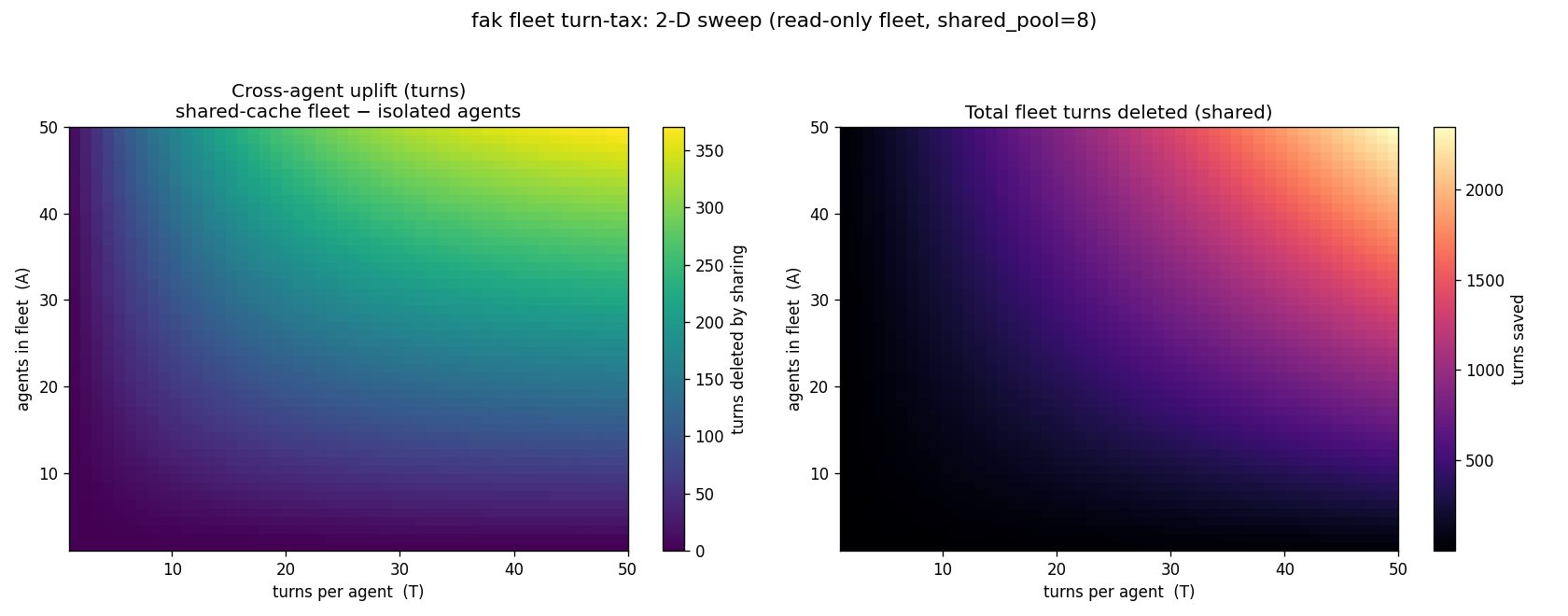
The same result as a fleet-vs-baseline comparison (the shared-cache fleet against the same agents run isolated, in absolute tool round-trips deleted — the shaded gap is the cross-agent uplift):
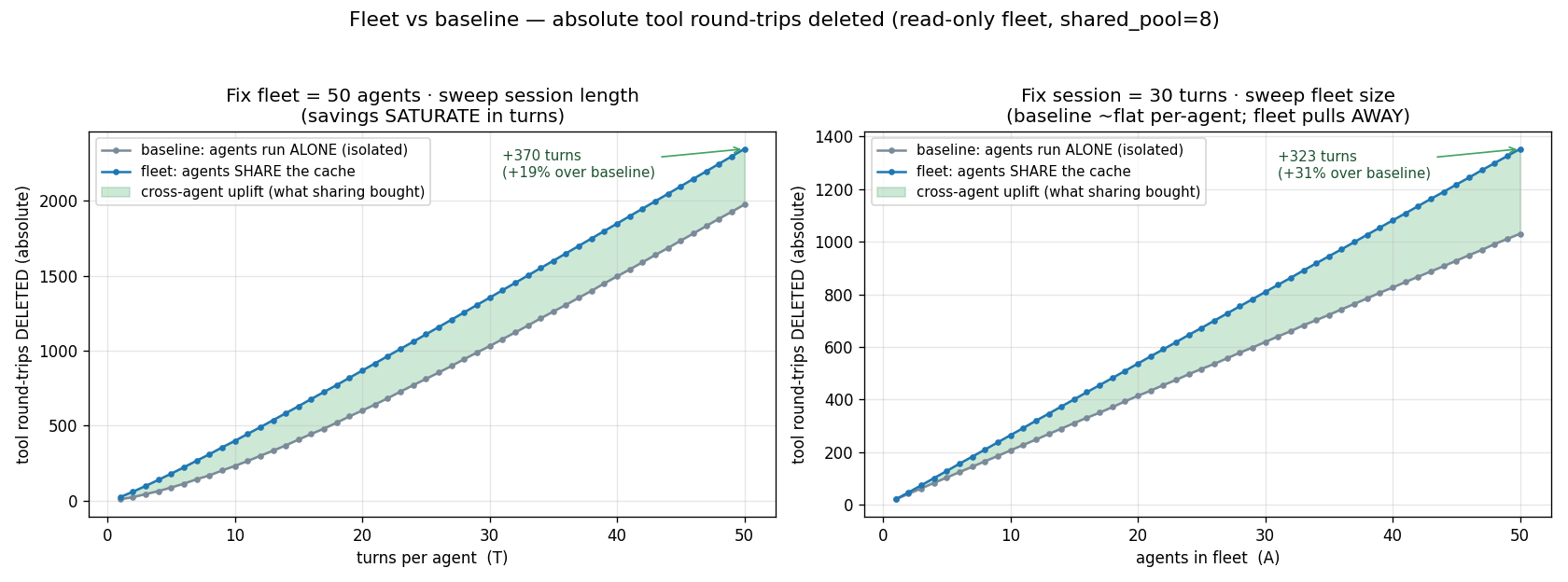
A read/retrieval fleet (research, monitoring, support-lookup): agents mostly
read shared reference data (a small catalog of shared_pool=8 popular routes),
repeat a few of their own lookups, do a little arithmetic — and do not write
(the write axis is §4; the zero rate is deliberate, see §4 for why). Representative
cells (medians over 64 seeded trials):
| T (turns) | A (agents) | calls = T·A | shared_saved | isolated_saved | cross_uplift |
|---|---|---|---|---|---|
| 1 | 50 | 50 | 25 | 10 | +14 |
| 10 | 10 | 100 | 74 | 47 | +28 |
| 10 | 50 | 500 | 399 | 233 | +167 |
| 20 | 20 | 400 | 342 | 241 | +102 |
| 30 | 30 | 900 | 809 | 619 | +190 |
| 50 | 10 | 500 | 462 | 395 | +68 |
| 50 | 1 | 50 | 39 | 39 | 0 |
| 50 | 50 | 2500 | 2344 | 1973 | +370 |
Read three things off this table:
shared_savedis the total turns the fleet deletes. At the T=50×A=50 corner the read-only fleet deletes 2344 of 2500 calls (94%) — a read-only fleet eventually serves almost everything from cache. Priced at the default cost model (1320 tok/turn, blended $3/$15 per Mtok): 3.09M tokens / $12.66 per fleet-run, of which the cross-agent bonus alone (the 370 uplift) is ~490k tokens / $2.00 the same agents run apart would not have saved.cross_uplift(shared − isolated) is the fleet-only win — the turns sharing buys that A independent agents cannot get.A=1is exactly 0 (nobody to share with): the cross-agent benefit is a strictly multi-agent phenomenon.- Agents matter more than turns for the uplift. Compare
T=10,A=50(+167) againstT=50,A=10(+68): the same 500 calls, but the short-session big fleet deletes 2.5× more — because uplift is linear in A but saturating in T (you can only cover a finite shared catalog). That asymmetry is the whole point of separating the two axes, and §3 makes it a formula.
§2 — The controls (why a positive number here is real)
| control | what it forces | result |
|---|---|---|
| no-share / no-write | agents share nothing → sharing CANNOT help | cross_uplift = 0.0000 across all 2500 cells (mean, p50, min, max) |
| single agent (A=1) | nobody to share with | cross_uplift = 0 across the whole distribution |
| write-heavy (30% writes) | every write bumps the global world | 93% of cells ≤ 0 (worst −100): sharing is a net LOSS |
The no-share surface is the load-bearing one: it is exactly zero everywhere
(not approximately), while its own shared_saved still ranges 0..2350 from
intra-agent dedup. So the harness credits cross-agent sharing only when sharing
actually happens — any positive cross_uplift in §1 is a real measured tier-2
event, not the benchmark flattering itself. (Tests: TestFleet_NoShareHasZeroCrossUplift,
TestFleet_SingleAgentHasNoCrossUplift.)
§3 — The scaling law (derived, then confirmed — not curve-fit)
The mechanism implies a closed form. Think of the pool distinct shared reads as
coupons to collect: the first agent primes each one (a cold engine call); every
other agent reads each already-primed coupon free. So the per-extra-agent uplift
is the expected number of distinct shared reads one agent makes in T turns —
coupon-collector coverage of the catalog:
cross_uplift(T, A) = (A − 1) · pool · (1 − (1 − 1/pool)^(p_shared · T))
With the workload’s own constants (pool=8, p_shared=0.45) and zero free
parameters, this predicts the full kernel-measured 2,500-cell surface at
adjusted R² = 0.9974. Its continuous approximation c·(1−e^(−T/τ))·(A−1), fit
freely, lands at adj R² = 0.99956 and recovers the derived constants:
asymptotic per-agent uplift c |
saturation knee τ (turns) |
adj R² | |
|---|---|---|---|
| derived (closed form) | pool = 8 |
pool/p_shared = 17.8 |
0.9974 (0 params) |
| fit (free) | 8.12 | 18.45 | 0.99956 |
The two agree to ~1.5%. That is the difference between “we drew a curve through the dots” and “we know why the dots are there.” The per-agent slope climbs and saturates exactly as coupon-coverage predicts:
| T | 1 | 5 | 10 | 20 | 30 | 50 |
|---|---|---|---|---|---|---|
| per-agent uplift (turns/agent) | 0.26 | 1.83 | 3.38 | 5.41 | 6.55 | 7.55 |
The total shared_saved(T,A) is near-perfectly bilinear (≈0.966·T·A, adj
R²=0.99967) — a read-only fleet caches ~everything, so savings scale with the call
count T·A, while the cross component is the saturating coupon term above.
§4 — The catch: lookers vs bookers (the most important finding)
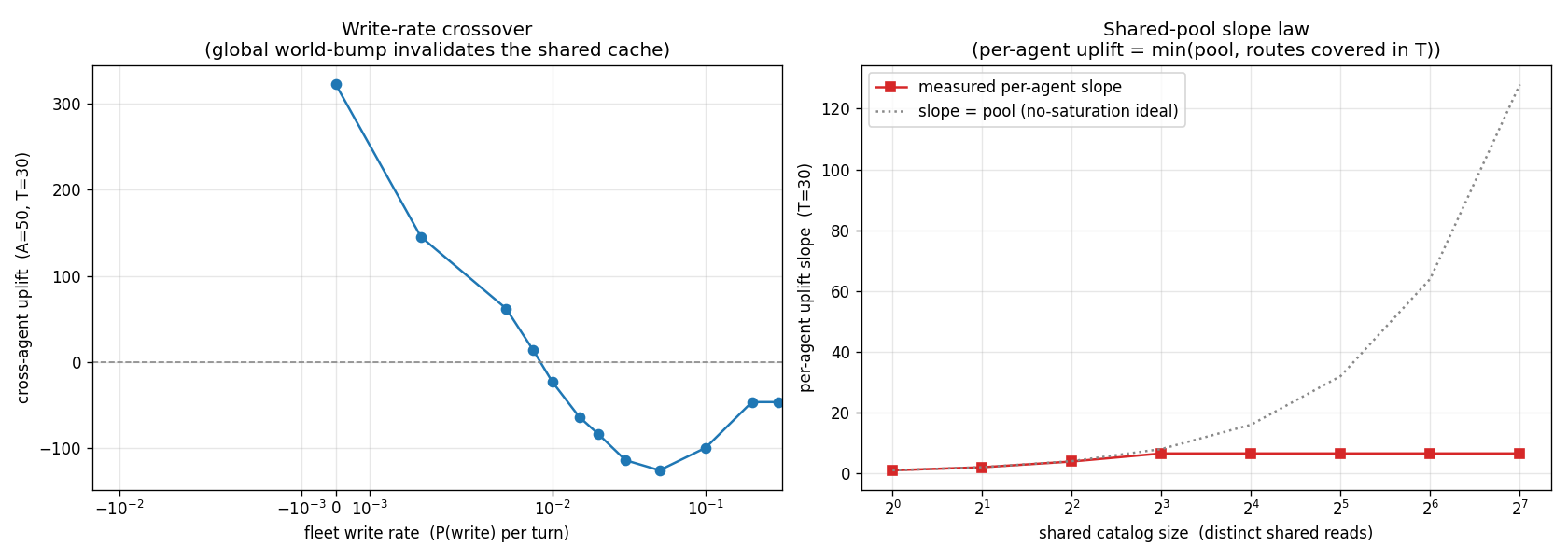
The shared cache lives under a soundness rule: a cache hit must equal a fresh
call, so any write bumps the world-version and invalidates the cache (the kernel
never serves a stale read — vdso.Emit). Today that bump is global: one write
clears the whole shared cache, not just the one key that changed. In an
interleaved fleet, one agent’s write erases every other agent’s warmed reads — a
cost the isolated baseline (whose agents mostly never write) does not pay.
The left plot sweeps the fleet write rate at A=50, T=30. The crossover is sharp:
| write rate | 0% | 0.25% | 0.5% | 0.75% | 1% | 2% | 5% | 30% |
|---|---|---|---|---|---|---|---|---|
| cross_uplift (A=50) | +322 | +145 | +62 | +14 | −23 | −84 | −126 | −47 |
Even a ~1% fleet write rate flips cross-agent sharing from a big win to a net loss. This is the real architectural result, and it forks the recommendation:
| your fleet is mostly… | share the cross-agent cache? |
|---|---|
| reading / looking up / researching / monitoring | yes — clean win, grows ~linearly with fleet size (§1, §3) |
| writing / booking / sending / editing | no — the global invalidation back-fires (§2 write-heavy, this table) |
And it names the fix: scoped invalidation — evict only the key(s) a write
changed, not the whole cache. That fix is now built, measured, and unit-proven:
the vDSO carries a Granularity (global = v0.1 full flush · namespace =
per-resource-class · resource = per-entity; internal/vdso/scope.go), every sweep
runs under any eraser via fleetbench --granularity, and
TestFleet_FinerEraserPushesCrossoverOut asserts the recovery on the live kernel.
The eraser sweep (A=50, T=30, mean over 32 seeded trials, same generated work)
makes the fix one glance — each row is that 32-trial mean, so a lone outlier cannot
move it:
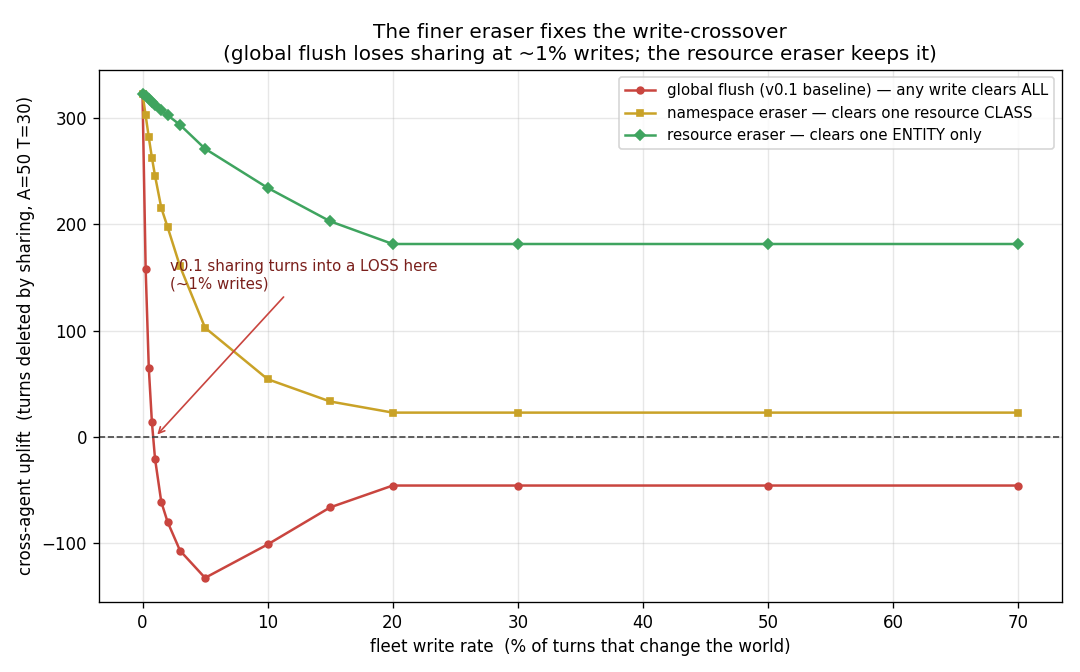
| write rate | global (v0.1) | namespace | resource |
|---|---|---|---|
| 0% | +323 | +323 | +323 |
| 0.5% | +59 | +281 | +319 |
| 1% | −23 | +242 | +313 |
| 5% | −132 | +100 | +271 |
| 10% | −102 | +55 | +235 |
The global eraser is the only one that ever goes negative; the resource
eraser keeps 97% of the no-write uplift even at a 1% write rate (313 of 323) and
is still strongly positive (+235) at 10% writes. So the crossover the §4 title
warns about is a property of the coarse v0.1 eraser, not of cross-agent sharing
itself — the finer eraser pushes it out past any realistic fleet write rate.
(The rows above are a representative slice of the full 0–70 % write-rate ladder
the sweep covers — regenerate the whole ladder, and check any single row against its
raw per-cell measurement, with wsl bash ./tools/eraser_sweep.sh. It writes the
per-cell JSON/CSV plus the rolled-up eraser-summary.csv under
experiments/fleet/eraser/ — generated locally, not committed.)
(The right panel of the axes figure at the top of this section is the catalog-size
law: per-agent uplift
tracks slope = pool until the pool outgrows what T turns can cover, then saturates
— min(pool, routes covered in T), exact for pool ≤ 8.)
§5 — Caveats (read before quoting any number)
- What a “turn” is here. A
cross_upliftof +370 is 370 tool round-trips the fleet served from a peer’s cached result instead of dispatching to the tool backend, priced at the same per-turnCostModelas the single-agent turn-tax. It assumes a ReAct-style loop where each tool call is a round-trip. It is not 370 saved model reasoning turns; it is saved tool round-trips (and their latency / re-prime / re-consume tokens). - Regime — but MORE portable than the §3.1 KV story. This is harness-level result caching (the kernel/gateway), not in-tensor KV splicing. So unlike TURN-TAX §3.1’s “self-host only” upside, cross-agent tool-result dedup is available to an API consumer who fronts their fleet with one fak gateway — provided (a) the fleet shares that gateway, (b) the reads are genuinely identical (content-addressed), and (c) the workload is read-heavy (§4).
- This is a happy-path (efficiency) axis only. Same two-axes discipline as the
stochastic harness: the fleet workload carries no poison and no deny. The
kernel’s safety floor (keeping injections out of context, refusing destructive
ops) is a separate, completion-integrity axis, measured elsewhere
(
TURN-TAX-RESULTS.md §1,LIVE-RESULTS.md), and holds whether or not this caching is on. Cross-agent safety interaction (could agent 1 poison agent 2 via the shared cache?) is its own axis — and is structurally bounded here because the ctx-MMU pages a quarantined result out before it is cached, so a shared serve hands back the paged-out pointer, not live poison; the durable form of that guarantee is the recall/canon line. - Determinism. Every cell is seeded; the same
(profile, T, A, trials, seed)reproduces the identical surface byte-for-byte (TestFleet_Determinism).
§6 — The fleet-scale ceiling (the analytic complement)
The kernel sweep is the grounded floor: turns the kernel verifiably deletes
on real syscalls, with a saturating law. Its analytic complement,
inline_tool_roi.py (now extended to a 2-D agents N × calls-per-agent K
surface), is the fleet-scale ceiling: the GPU cold-KV re-prefill $ a
two-pass loop burns, which is bilinear and UNBOUNDED in (N, K) — no saturation.
That contrast is the point: the two axes the kernel sweep shows saturating (a
finite shared catalog, a finite per-session error budget) are the same two the
fleet-$ tax shows compounding. The kernel deletes a bounded tax per session,
deterministically; the unbounded tax is the self-host-regime ceiling the same
construction reaches for (with the §3.1 regime caveats). See
inline-tool-roi-results.md.
§7 — Bottom line
- The agent-count axis is real and measured, not modeled (§ intro, §2): the cross-agent uplift is the kernel’s own tier-2 VDSOHits, proven by a shared-vs- isolated path-swap, with an exactly-zero anti-inflation control across 2,500 cells.
- The surface has a derived closed form (§3):
cross_uplift = (A−1)·pool·(1−(1−
1/pool)^(p_shared·T))
predicts the kernel data at adj R²=0.997 with zero free parameters — linear in agents, coupon-collector-saturating in turns. The fleet win is calculable, not just observed. - It only holds for read fleets (§4): a ~1% write rate flips it from a big win to a net loss, because the kernel’s world-bump invalidation is global. That is the honest negative result and the concrete next build (scoped invalidation).
- The visuals carry the story for any reader (
visuals/fleet-sweep-*.svg,experiments/fleet/fleet-heatmap.png,fleet-axes.png), andFLEET-SWEEP-EXPLAINED.mdsays all of the above with no math.