GPU-QWEN-RESULTS — real agentic models on the laptop GPU: f16 parity (1.5B) + reaching 2.5–3B (Q8)
Two results, one box (RTX 4070 Laptop, Ada sm_89, 8188 MiB / ~6.2–7.4 GiB free, CUDA 12.6, WSL2;
llama.cppbuilt with CUDA in the same env):
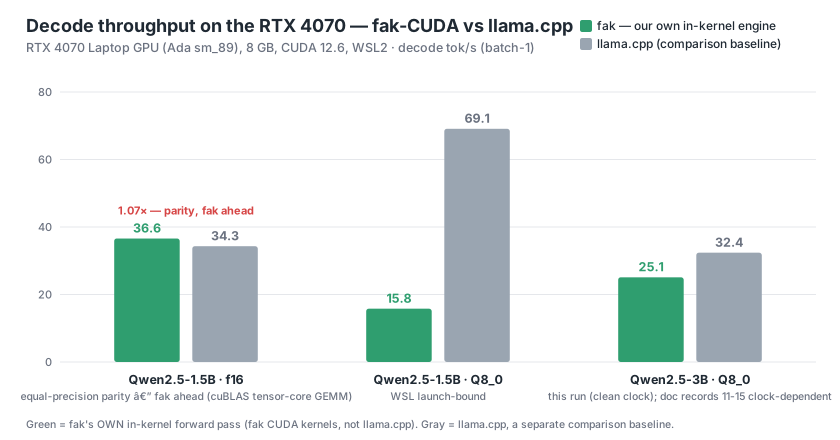
- Equal-precision decode parity, Qwen2.5-1.5B-Instruct. With an f16 weight path, fak-CUDA decodes at ~36.6 tok/s vs
llama.cppF16 34.3 (fak ~1.07×) — a win at the same precision, correctness witnessed greedy argmax-exact vs the f32 reference on the real model. This is the first fak-vs-llama.cpphead-to-head on a genuinely capable agentic model (the prior GPU witness was SmolLM2-135M,GPU.md§3b).- Reaching the 2.5–3B class, Qwen2.5-3B-Instruct. f16 (2 bytes/param) tops out at ~1.5B on this 8 GB-laptop’s free VRAM, so a Q8_0 weight path (~1.125 bytes/param) was added: Qwen2.5-3B now runs on the GPU, witnessed argmax-exact, fitting ~3.5 GiB. Its decode is WSL-launch-bound (~11–15 tok/s vs
llama.cppQ8 32.4) — an environment + tracked-optimization gap, not architecture (analyzed in §4).Companion to
GPU.mdandGPU-MODEL-PICK.md. Every number here is a real run captured in bench/test output; the boundaries are stated as plainly as the wins.
1. What shipped — narrowed-weight device paths (issues #34, #33)
The CUDA backend was f32-only (weights 4 bytes, cuBLAS SGEMM). Two gated paths narrow the resident weights — the lever that fits a multi-billion-param model on an 8 GB GPU:
| Path | Gate | Resident weight | Device GEMM | Where |
|---|---|---|---|---|
| f16 | FAK_CUDA_F16=1 |
2 bytes/param | cublasGemmEx half×half→f32, Ada tensor cores |
cuda_kernels.cu:fcuda_matmul_f16 |
| Q8_0 | FAK_CUDA_Q8=1 |
~1.125 bytes/param (int8 + per-32-block f32 scale) | fused dequant-GEMV (k_matvec_q8, char4/float4 vectorized, W8A16) |
cuda_kernels.cu:fcuda_matvec_q8 |
Both keep activations f32 (RMSNorm/RoPE/attention numerics unchanged; only the GEMM input is narrowed/dequantized), so the rest of the loop is dtype-agnostic and the output stays f32. Plumbing (all behind existing seams, default-off, cpu-ref Reference path byte-for-byte untouched):
Upload(t, F16|Q8_0)narrows on the device; a Q8 tensor uploads int8 codes + scales (cuda.go). The backend declares its preference viaPreferredWeightDtype()(Q8 > F16 > F32).- The HAL’s
matWeightHALuploads matmul weights narrowed; norm weights + biases stay f32. Q8 weights come from the lean store (m.q8w,LoadSafetensorsQuantDir) so a quant-only model never needs the dropped f32 — which is how the sharded 3B loads in ~4 GB host RAM (its f32 blob would be ~12 GB).
2. Correctness — witnessed kernel → synthetic → real model
| Witness | Result | Where |
|---|---|---|
| f16 GEMM vs cpuref f32 | cosine 1.00000000, maxAbs 1.82e-03 | TestCUDAMatMulF16MatchesRef |
| Q8 GEMV vs cpuref f32 | cosine 0.99999976, maxAbs 2.5e-02 | TestCUDAMatMulQ8MatchesRef |
| synthetic Llama decode, f16, vs f32 native | argmax-exact /10, prefill cos 0.99999983 | TestHALDeviceForwardMatchesNative (FAK_CUDA_F16=1) |
| real Qwen2.5-1.5B, f16 vs f32 | argmax-exact /12 — coherent English | cmd/gpucheck |
| real Qwen2.5-1.5B, Q8 vs f32 | argmax-exact /10 | cmd/gpucheck -backend cuda |
| real Qwen2.5-3B, Q8 vs cpu-Q8 | argmax-exact /8 | cmd/gpucheck -lean |
Suite green across all five permutations — f32, graph, f16, f16+graph, Q8
(internal/compute/build_cuda.sh test).
3. The head-to-head — decode, same RTX 4070
fak: median of repeated modelbench runs (decode-steps 128, prompt 16). llama.cpp:
llama-bench -ngl 99 -n 128 -r 5. Run-to-run variance is ±10–15% (laptop GPU clock + 9p +
peer sessions), so ranges are given where seen.
Qwen2.5-1.5B-Instruct
| engine | precision | bytes/param | decode tok/s | vs fak f16 |
|---|---|---|---|---|
| fak-CUDA | f16 | 2 | ~36.6 (34.9–37.8; peak 53 on a clean clock) | — |
llama.cpp |
F16 | 2 | 34.3 | fak 1.07× — parity, fak ahead |
| fak-CUDA | Q8_0 | 1.125 | 15.8 | (launch-bound, §4) |
llama.cpp |
Q8_0 | 1 | 69.1 | |
llama.cpp |
Q4_K_M | 0.5 | 93.1 |
At equal precision (f16), fak decode is at parity with — slightly ahead of — llama.cpp.
fak’s f16 GEMM is cuBLAS tensor-core; that is why fak does relatively better here than at
135M (where it was launch-bound). Decode stays flat as context grows: at 768 tokens fak f16
still decodes 36.5 tok/s.
Qwen2.5-3B-Instruct (the 2.5–3B target)
| engine | precision | size on GPU | decode tok/s |
|---|---|---|---|
| fak-CUDA | Q8_0 | ~3.5 GiB (fits the ~6.2 GiB free) | ~11–15 (clock-dependent) |
llama.cpp |
Q8_0 | 3.36 GiB | 32.4 |
Qwen2.5-3B runs on the GPU, correct (argmax-exact). fak’s Q8 decode is ~0.4× llama.cpp’s
— not parity, and §4 is honest about why.
4. Why Q8 decode is behind — it’s the WSL launch tax, not the kernel (and not architecture)
A batch-1 decode issues ~600 device ops/token. On WSL each op carries a ~0.07 ms host
launch tax (microbench, GPU.md §3b) → a ~42 ms/token floor independent of compute. Three
measurements pin the cause to launches, not the GEMV inner loop:
The per-op tax is backend- and OS-dependent — don’t carry this number across backends. The ~0.07 ms/op here is CUDA-on-WSL. The Vulkan/native-Windows path measures a ~2 ms/op floor (~28× higher;
VULKAN-AMD-RESULTS.md§”Why it is slow”). So a reader projecting GPU decode on another box must apply the per-op tax for that backend — 0.07 ms/op is CUDA-on-WSL, ~2 ms/op is Vulkan/native — not assume one floor everywhere.
- char4/float4 vectorizing the Q8 GEMV changed nothing (3B 90.3 vs 90.1 ms) — the inner loop is not the bottleneck.
- A W8A8
__dp4aGEMV (llama.cpp’s technique) made it SLOWER (1.5B 15.8 → 11.0 tok/s) — its per-matmul activation-quant kernel adds a launch, and on WSL the extra launch costs more than__dp4a’s compute saves. (Reverted; the finding is the value.) - The CUDA graph that fixed this for the 135M model (12 → 120 tok/s) doesn’t engage on the
large multi-layer graph: capture hits a
cudaMallocmid-stream (cuda_kernels.cu:67, “operation not permitted when stream is capturing”) and falls back to op-per-call. The pre-warm doesn’t cover every transient buffer size the 28–36-layer graph allocates.
So the Q8 speed lever on this box is a capture-safe CUDA graph (pre-warm or arena every
transient so capture never allocates), not a faster kernel. Native Linux (no per-call tax)
starts from a far lower floor. This mirrors the CPU axis (LLAMACPP-HEADTOHEAD-RESULTS.md):
fak’s gap to llama.cpp is a tuning/runtime boundary, not an architecture ceiling — and at
f16, where fak rides cuBLAS, it already wins.
5. “How much it can grow” — agentic-context headroom
Weights are fixed once resident (1.5B f16 ≈ 3.0 GiB; 3B Q8 ≈ 3.5 GiB); the rest of the
~6.2 GiB free budget is agentic-context capacity. fak’s device KV keeps K, Kraw, and V per
layer (Kraw is the retained pre-RoPE key that lets Evict reposition a survivor in one
rotation — the bit-exact KV-quarantine security primitive), f32:
1.5B KV = 28 layers × 2 kv_heads × 128 head_dim × (K+Kraw+V) × 4 B = 84 KiB / token
So with Qwen2.5-1.5B f16 resident (~4.4 GiB measured incl. CUDA context + KV), the ~2.7 GiB
of remaining budget is ~32k tokens of context for one agent, or tens of concurrent
agents each holding a working set — and the kernel-owned KV makes the multi-agent regime
safe: cudaKV.Clone deep-copies a shared prefix into each agent (cross-agent reuse) and
Evict removes a poisoned span bit-exactly, per agent (kvreuse_test.go, evict_test.go).
Turning that headroom into measured multi-agent throughput on the device is the batched-decode
follow-up (same as §6’s prefill). Two levers shrink the per-token KV further: f16 device KV
(→ 42 KiB/tok, ~74k tokens) and dropping Kraw when per-agent Evict isn’t needed.
6. Honest residue / what’s next
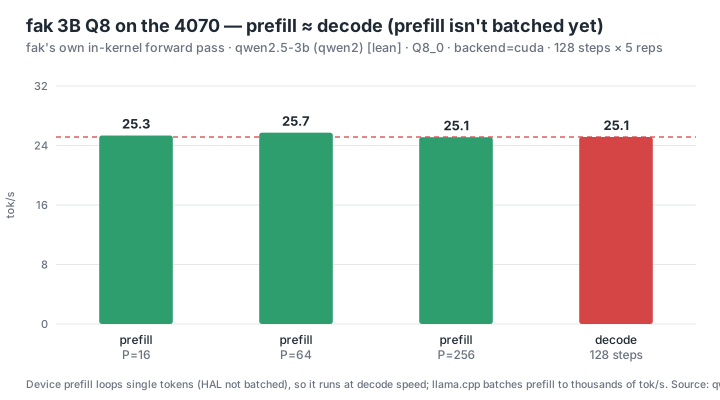
- Prefill isn’t batched on the device path — the HAL prefill loops single tokens, so fak
prefill ≈ decode speed while
llama.cppbatches (pp256 ≈ 2330–4882 tok/s).BatchedMatMulis f16/Q8-ready; the HAL prefill rewrite + batched device attention is the follow-up. - Q8 decode is WSL-launch-bound — the capture-safe-graph fix (§4) is the lever; until then,
3B Q8 is ~0.4×
llama.cppon WSL. - 2.5–3B at f16 doesn’t fit this 8 GB-laptop (6.2 GiB weights == the whole free budget); Q8/Q4 is required, and Q8 is what shipped. 7B would need Q4 device weights (#33 extends to it).
7. Reproduce
Committed data + charts: this 3B Q8 run is shipped as machine-readable data with inline charts in
experiments/gpu/— decode-vs-llama · prefill≈decode. Every fak number there is fak’s own in-kernel CUDA forward pass;llama.cppis the comparison baseline only.
bash internal/compute/setup_cuda_wsl.sh        # one-time CUDA toolchain (GPU.md §1)
bash internal/compute/build_cuda.sh test       # all five permutations green

# f16 parity, Qwen2.5-1.5B (single-file safetensors):
FAK_CUDA_F16=1 go run -tags cuda ./cmd/modelbench -hf <qwen2.5-1.5b-dir> -backend cuda -decode-steps 128 -decode-reps 5
FAK_CUDA_F16=1 go run -tags cuda ./cmd/gpucheck   -hf <qwen2.5-1.5b-dir> -backend cuda -n 12

# Q8 to reach 3B (sharded -> lean Q8 load):
FAK_CUDA_Q8=1  go run -tags cuda ./cmd/modelbench -hf <qwen2.5-3b-dir> -lean -backend cuda -decode-steps 128
FAK_CUDA_Q8=1  go run -tags cuda ./cmd/gpucheck   -hf <qwen2.5-3b-dir> -lean -backend cuda -n 8

# llama.cpp baselines, same box:
llama-bench -m qwen2.5-1.5b-instruct-f16.gguf -ngl 99 -n 128 -r 5
llama-bench -m qwen2.5-3b-instruct-q8_0.gguf  -ngl 99 -n 128 -r 5
8. Bottom line
- f16, Qwen2.5-1.5B: equal-precision decode parity REACHED — fak ahead (~36.6 vs 34.3 tok/s), correctness argmax-exact vs f32 on the real model. fak’s cuBLAS tensor-core f16 GEMM is the peer of llama.cpp’s F16.
- Q8, Qwen2.5-3B: the 2.5–3B target REACHED on the GPU, correct (argmax-exact, fits ~3.5 GiB). Decode is WSL-launch-bound (~11–15 vs 32 tok/s) — a capture-safe CUDA graph is the lever (§4), not architecture; native Linux starts far lower.
- Levers were small and modular: an f16 path (
cublasGemmEx) and a Q8 path (fused dequant-GEMV + lean sharded load) behind the existingUploadDtype/PreferredWeightDtypeseams, gated, default-off, Reference bit-identity witness untouched, suite green across f32/graph/f16/f16+graph/Q8.