TURN-TAX-RESULTS — the deterministic safety floor, plus the error-code turn measured and ablated
The microsecond bench (
fak bench,internal/bench) answers “how cheap is one in-process adjudication vs a spawned hook?” — a sub-µs transport question. It deliberately does not price the cost that actually dominates an agent loop. This document measures two distinct things, and keeps them structurally apart because they are not the same kind of claim:
- The Measured Safety Floor (§1) — the moat. A poisoned result kept out of context, a destructive op never dispatched — a deterministic completion/integrity delta that holds on any backend, including a frontier API you do not own. This is the engine-agnostic trust floor and it is not optional.
- The efficiency upside (§3) — self-host regime only. When a SOTA tool-calling loop hands the model a tool that came back as an error code (malformed args, a duplicate read, a result that needs repair), the documented recovery is to feed the error back and re-prompt: one extra turn. fak’s 1-shot path can resolve the same condition inside the syscall the call arrived on. That is real, but it is an upside you collect only when you own the fused binary — never the headline (see the guardrails in §3.1).
The fak side is not modeled — it is the live kernel. Every number is a replay of a frozen, class-labeled trace through the real
k.Syscall, read from the kernel’s own counters (Transforms,VDSOHits,Quarantines,Denies). The report carries aconsistency_check: "ok"— a consistency guard that the bench’s per-call bucketing agrees with those counters (it catches a wiring/bucketing drift; it is not an independent oracle, since the classification reads the same verdicts the counters came from — the grounding is that the kernel emits the events, not that two correlated tallies match). The only modeled half is the efficiency baseline, and its saved turns split into two honestly-different kinds (§3).Reproduce:
fak turntax --suite turntax-airlineand--suite turntax-happy. Code:internal/turnbench/, fixturestestdata/turntax/, artifacts underexperiments/turn-tax/.Watch it live.
go run ./cmd/turntaxdemo(openhttp://127.0.0.1:8150) replays a trace through the real kernel call-by-call and shows three lanes — a naive SOTA loop’s counter ticking up on every aliased / duplicate / elidable call (+9), a tuned framework that elides the optional calls but still pays the forced error-recovery turns (+5), and the fak lane staying flat (0) — with the §1 safety floor on a deliberately separate strip. It needs no model weights (the trace runs throughk.Syscall, not a model), so it reproduces identically on any box; add-selfcheckto assert those numbers headless (no browser — the CI / cross-platform dog-food). Flip the suite toturntax-happyand every counter stays at 0 — the §4 anti-inflation control, made watchable.
§1 — The Measured Safety Floor (the moat; read this first)
On the 14-call turntax-airline slice — one realistic airline-support session —
the kernel produces a deterministic integrity delta that the SOTA baseline
does not:
| axis | metric | baseline (SOTA loop) | fak | delta |
|---|---|---|---|---|
| safety floor | injections admitted to context | 1 | 0 | quarantined |
| safety floor | destructive ops executed | 1 | 0 | denied |
This is a completion/integrity delta, not a turn count. A poisoned document
is paged out of context before it can derail the session (Quarantines); a
destructive operation (delete_account) is refused as a deny-as-value
(Denies). Both are verdicts the model did not author.
Why this is the moat — and why it is engine-agnostic. The safety floor is the
part of the kernel that needs no fused runtime and no ownership of the serving
stack. It sits in front of whatever engine answers the call — a local 3B or a
frontier API — and adjudicates the syscall from non-authored evidence. It is
reproducible on any backend: the same admission gate and capability floor fire
whether the tool result came from a model you host or one you merely call over an
API. This is the deterministic external floor; it is non-optional and it does not
depend on the efficiency story below. (The complementary live A/B — fak agent,
LIVE-RESULTS.md — shows the operational shape of the same fact: 0% vs 100% task
completion under poison, while the happy-path turn-saving is ≈0.)
§1.1 — Caveat: the quarantine demo is isolated by call ordering, for test clarity
fetch_policy carries the substring “fetch”, so the IFC sink-gate classifies it
as an egress sink. The slice runs it first, while the session is still
untrusted, so it reaches the engine and ctx-MMU quarantines the poisoned doc — the
lever this row demonstrates. In a realistic session a read like
get_user_details would taint the session first, and IFC’s sink-gate (rank-30,
pre-call) would then refuse the fetch_policy egress call before ctx-MMU
ever saw a result — so end-to-end, the IFC sink-gate, not ctx-MMU quarantine, is
the primary injection defense. The quarantine lever is real and sound; this
fixture isolates it artificially to show it in isolation. delete_account is the
converse: a destructive sink we want refused — policy and IFC both deny it.
§2 — Why a separate benchmark (and what each one is for)
| benchmark | question | unit | gate |
|---|---|---|---|
internal/bench |
cost of one adjudication vs a process spawn | nanoseconds | by-construction (in-proc < spawn) |
internal/turnbench (this) |
safety floor (§1) + model turns deleted per lever (§3) | integrity delta + turns → tokens/$/s | consistency guard + happy-path=0 |
A frontier turn is ~10⁹× an in-process Decide (here: 1.5 s vs ≈2 µs — the
re-measured local_serve_ns in the artifact). The safety floor (§1) is the
non-optional reason to run the kernel at all; the turn-count below (§3) is what
the same construction additionally buys you in the self-host regime.
§3 — Efficiency upside (self-host regime only)
Read §3.1 before quoting any number here. The turn-savings below are a cache-favorable slice in a regime where you own the fused binary. They are not a general agent speedup, and they are not available at all if you call a frontier API (you still get the §1 safety floor in that case). The moat is §1; everything in §3 is optional upside collected only when you self-host.
On the same 14-call turntax-airline slice — exercising every kernel lever —
native run on this box:
| axis | metric | baseline (SOTA loop) | fak (1-shot) | delta |
|---|---|---|---|---|
| turn-tax | extra model turns fired | 9 | 0 | −9 turns |
| turn-tax | — of which forced (re-issued read + aliased retry) | 5 | 0 | −5 |
| turn-tax | — of which elision (pure/static the model could omit) | 4 | 0 | −4 |
| turn-tax | tokens (@1200+120/turn) | 11,880 | 0 | −11,880 |
| turn-tax | $ (@ $3/$15 per Mtok) | $0.0486 | 0 | −$0.0486 |
| turn-tax | added latency (@1.5s/turn) | 13.5 s | ~0 (≈2 µs serve) | −13.5 s |
The honest decomposition of the 9. Five are forced — the model already
issued the call and the baseline demonstrably pays the round-trip: a re-issued
duplicate read (3) and an aliased call that errors and must be re-prompted (2,
the documented ReAct retry). Four are elision — tool calls the model made
(calculate, list_all_airports) whose results need no engine; the baseline
pays a round-trip only because the model chose to call a tool a stronger agent
could elide (compute inline, recall the list). fak serves those locally either
way, so it is a capability win, counted toward the total but reported apart so
the claim isn’t overstated. The 9 is exact for this trace: the kernel counts
only calls actually present, so a model that never aliases (Transforms→0) or
never calls a pure tool simply yields fewer — the cost model cannot over-count a
turn the workload didn’t contain.
§3.1 — Guardrails (read before quoting the 9)
Not a general speedup — this is a cache-favorable slice. The 14-call slice is deliberately error/dup/pure-rich so every lever fires at least once. On real tau2-airline the measured addressable vDSO purity is ~0.7% — far below a useful threshold, which is exactly why CLAIMS.md scopes the vDSO as an “UPSIDE secondary, never the headline.” The “9 on this trace” must not be extrapolated to “agents save 9 turns”: this slice is to the real-world hit-rate what a cache-hit microbenchmark is to a cold workload.
Regime trifurcation — the fleet-scale formula does not apply uniformly. The
in-process turn-saving depends on who owns the serving stack (see
frontier_sensitivity.py, the build-cost interrogation):
| regime | turn-savings available? | marginal build cost |
|---|---|---|
| API consumer (you call a frontier API) | N/A — the in-process win is unavailable; you still get the §1 safety floor | not for sale (provider must expose in-tensor tool calling) |
| provider ships it in-process | yes | ≈ $0 marginal |
| self-host fork | yes | ≈ $2.8M / 3yr TCO — not the $200k “knob” |
The frequently-quoted $200k is the model’s only un-anchored number and is a bare knob; the honest self-host total — a divergent KV-splice fork (~3 eng-yr, “out of reach” on OSS vLLM) plus recurring format re-train and fork-maintenance — is ~$2.8M over 3 years (~14× the knob).
Derivation of the $2.8M figure:
- Divergent KV-splice fork: ~3 engineer-years × ~$600k/yr ≈ $1.8M
- Format re-train: one-time cost ≈ $500k
- Fork-maintenance over 3 years: ≈ $500k
- Total: ~$2.8M over 3 years
Derivation of the $200k knob:
The $200k figure comes from inline_tool_roi.py (not published in this repo),
which models the GPU-side re-prefill tax of two-pass loops at fleet scale.
That script treats $200k as a sensitivity knob (a BUILD_COST constant) rather
than a measured benchmark. The derivation of this knob is not available in
the public repo; it is intentionally marked as “un-anchored” here because it
does not reflect a measured build cost.
The turn-savings in this section therefore apply only to the self-host / provider-ships regime; an API consumer
gets the safety floor and none of this.
Prior-art honesty — no single lever is novel. Each mechanism the 9 is built from is established:
- grammar-repair — constrained decoding / grammar-coerced tool args is established practice (GBNF, XGrammar, SGLang structured output).
- vDSO tier-2 dedup — content-addressed tool-result caching with a provably-unchanged check is established (TVCache, arXiv:2602.10986; tool-result-cache over canonical JSON).
- prompt / KV prefix caching — established across the serving field.
The only defensible novelty is the integrated assembly at the syscall boundary — resolving the condition in-syscall across grammar + vDSO + the adjudicator as one fast path — not any single lever. No reader should infer a novel mechanism here; the claim is the assembly, not the parts.
Right baseline — ~2–2.5×, not 5–15×. Against a tuned SGLang + harness
(already batching across requests, prompt-caching on), the serving win is
~2–2.5× (resident KV avoiding re-prefill under eviction pressure +
fleet-owned bubble-filling + vDSO/pre-flight token savings) — see
BRAINSTORM-fused-agent-kernel-2026-06-16-NUMBERS-AND-HURDLES.md. The large
5–15× multiples apply only against a naive single-agent-per-GPU baseline
(almost all of which is just having continuous batching at all) or to the vDSO
subset. A number benchmarked against naive single-tenant will not survive contact
with a real serving baseline.
§3.2 — The modeled baseline — two honestly-different kinds of saved turn
The fak side is real kernel events; the efficiency baseline is a transparent cost model. Its saved turns are not one uniform thing, and conflating them would overstate the claim. They split in two:
Forced — the model already issued the call, and the baseline demonstrably pays the round-trip. This is the sound, documented case (ReAct / function-calling / tool-use): on a tool error code the loop feeds it back and re-prompts (+1 turn; we charge the conservative 1, not a flail loop).
This +1 is now witnessed, not just modeled. A live error-injecting A/B (
internal/agent/inject.goover thefak agentloop, modelgemini-2.5-flash) corrupts one canonicalconvert_currencyarg to a grammar alias per arm: the fak arm repairs it in-syscall (0 retries, 1Repair); the baseline tool rejects it and the live model spends exactly one extra turn recovering (7 vs 6 turns), with both arms still completing the booking. Measured retry-turns-per-error = 1.00 across 3/3 trials (distinct transcript SHAs → genuine re-planning). Artifact:experiments/agent-live/turntax-injection-live.json. Caveat: n=3, one strong model, one alias shape — a weaker model could need >1 retry or derail, which the harness’sboth_completedgate flags not comparable (a recorded negative control: re-corrupting every retry spins the baseline to the turn cap, task failed). So +1 is the clean-recovery floor, confirmed live for this model.
| class | what the baseline pays | fak’s 1-shot | kernel event |
|---|---|---|---|
| grammar | tool errors on aliased args → reparse turn | from→from_currency repaired in-syscall (TRANSFORM) |
Transforms |
| vdso dedup (t2) | re-issues a duplicate read it already made | served from content-cache | VDSOHits (tier 2) |
Elision — the model called a tool whose result needs no engine. The baseline pays a round-trip only because the model chose to make a call a stronger agent could have elided. This is a capability/optimization win, not a forced error-recovery turn — so it is counted toward the total but reported separately.
| class | what the baseline pays | fak’s 1-shot | kernel event |
|---|---|---|---|
| vdso pure (t1) | round-trips for a pure fn the model could inline | computed locally, no engine | VDSOHits (tier 1) |
| vdso static (t3) | round-trips for a canned answer the model could recall | served from static table | VDSOHits (tier 3) |
| pass (control) | one engine turn | one engine turn | — (0 saved) |
| quarantine | admits poison → derail | result paged out of context | Quarantines (safety, §1) |
| deny | executes destructive op | refused as deny-as-value | Denies (safety, §1) |
turns_saved = Transforms + VDSOHits (forced 5 + elision 4 = 9) — nothing else.
Quarantine/deny are not in the turn-tax (their value is the §1 safety floor),
so there is no double count.
§3.2.1 — From a point to a distribution (stochastic grounding)
The 9 is one trace, and a single point can be cherry-picked. A deterministic
stochastic harness (internal/turnbench/stochastic.go) addresses that: it starts
from a clean 14-call base that saves 0, injects the four happy-path classes
(alias / dup / pure / static) at per-call rates over 200 seeded trials, and
replays each through the real kernel. The turns-saved distribution is monotone in
the error rate, and a zero-rate profile collapses the whole distribution to 0 (the
anti-inflation control holds under stochastic sampling too):
| error-mix profile | rates (alias/dup/pure/static) | p10 | p50 | p90 |
|---|---|---|---|---|
| low (careful loop) | .10/.10/.10/.05 | 2 | 5 | 7 |
| mid (typical loop) | .30/.30/.25/.20 | 10 | 14 | 18 |
| high (under-grounded) | .55/.55/.50/.40 | 22 | 27 | 31 |
| zero (control) | 0/0/0/0 | 0 | 0 | 0 |
So the per-session win is error-rate-dependent, not a constant: “9” is a
mid-ish point, it bottoms out at 0 for a clean loop (the §4 calibration slice),
and it only grows where the workload is genuinely error/dup-rich (which §3.1’s
~0.7% real vDSO hit-rate says is the exception, not the rule). Artifact:
experiments/turn-tax/turntax-stochastic.json.
§3.2.2 — From a distribution to a break-even (the ~0.7% question, answered)
The distribution above is indexed by a four-class error mix; the one number
everyone quotes against — §3.1’s ~0.7% real-world addressable rate — deserves
its own axis. The break-even sweep collapses the mix to a single scalar hit-rate
h (the fraction of eligible calls that are turn-tax-addressable, all four class
rates set to h) and replays the clean 14-call base through the real kernel at
each h over 200 seeded trials. For each point it prices the per-session net and
the §3.1 self-host amortization: at the honest ~$2.8M / 3yr self-host build
cost, how many sessions must run before the efficiency saving alone recovers it.
(fak turntax --breakeven; artifact experiments/turn-tax/turntax-breakeven.json.)
hit-rate h |
mean turns saved / session | p50 | p90 | $ saved / session | self-host break-even (sessions) |
|---|---|---|---|---|---|
| 0 (control) | 0.00 | 0 | 0 | $0 | never |
| 0.7% (real-world) | 0.33 | 0 | 1 | $0.0018 | ~1.6 billion |
| 2% | 1.06 | 1 | 2 | $0.0057 | ~489 million |
| 5% | 2.73 | 3 | 5 | $0.0147 | ~190 million |
| 10% | 5.58 | 5 | 8 | $0.0301 | ~93 million |
| 20% | 10.61 | 11 | 14 | $0.0573 | ~49 million |
| 50% | 27.18 | 28 | 32 | $0.1468 | ~19 million |
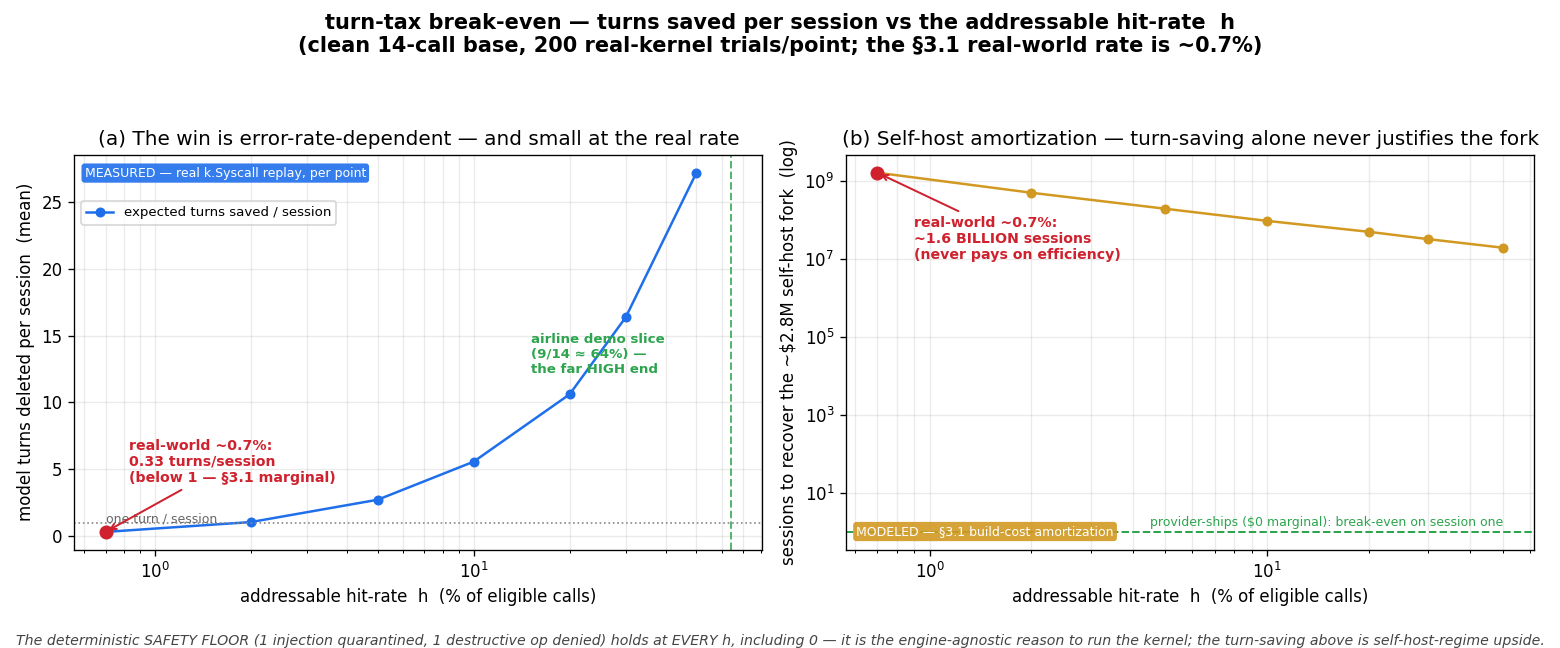
(Regenerate: fak turntax --breakeven then python tools/turntax_plot.py. Panel
(a) is the MEASURED per-session win — real-kernel replay per point; panel (b) is the
MODELED §3.1 self-host amortization. The red marker is the real ~0.7% rate; the green
dashed line in (a) is where the airline demo slice sits.)
The takeaway — and it strengthens the honesty, not the headline. At the real
~0.7% rate the efficiency win is 0.33 turns per session — less than one turn,
and the self-host fork would need ~1.6 billion sessions to pay for itself on the
turn-saving alone. That is the quantitative form of §3.1’s “marginal, never the
headline”: at the real rate, the efficiency axis does not justify the kernel — the
§1 safety floor does (it is engine-agnostic, non-optional, and present at every
h, including 0). The turn-saving only becomes a first-order economic lever above
~10% addressable, a regime that is the exception. The provider-ships regime is the
mirror image: its marginal build cost is ≈$0, so it breaks even on session one at
any positive h — the upside is free exactly where the binary is already yours. And
the airline demo slice (9 of 14 calls ≈ 64% addressable) sits at the far high end
of this curve by construction — it is the cache-hit microbenchmark, not the workload.
The h=0 row is the same anti-inflation control as everywhere else: zero saving, and
a positive build cost that never amortizes — the floor survives the projection.
§3.3 — The ablation — which lever drives the win
| lever | mechanism | turns saved | how it’s proven |
|---|---|---|---|
| grammar-repair | TRANSFORM in-syscall (alias→canonical) | 2 | Counters.Transforms == grammar-classified calls |
| vDSO (3 tiers) | local serve (pure / content-cache / static) | 7 | real ON/OFF path swap (below) |
| quarantine | context-MMU result admission | 0 (safety, §1) | Counters.Quarantines; injection kept out of context |
| deny | capability-floor adjudication | 0 (safety, §1) | Counters.Denies; destructive op never dispatched |
| NET (1-shot) | all turn-tax levers | 9 | grammar + vDSO |
The vDSO lever is not asserted by arithmetic — it is a real path swap. Re-run
the identical trace with the fast path disabled (SetVDSO(false)): the
vDSO-served calls fall through to the engine, so the only turns saved are the
grammar repairs, and the difference is exactly the live VDSOHits:
turns saved  vDSO ON  : 9
turns saved  vDSO OFF : 2     (grammar only)
vDSO contribution     : 7  ==  Counters.VDSOHits (7)   ✓ asserted in TestRun_VDSOAblationIsARealPathSwap
vDSO breaks down as tier-1 pure 2, tier-2 dedup 3, tier-3 static 2 —
read from each result’s tier tag, which the kernel now stamps on tier-1/tier-3
serves (it already did for tier-2), so the per-tier split is kernel-witnessed, not
inferred. (Reminder from §3.1: these multiples are this cache-favorable slice, not
the ~0.7% real-world rate.)
§3.4 — Net results under different stacks (the turns are fixed; the price is not)
The kernel fixes the turns; the per-turn price is a knob. Sensitivity over the two that move the net (round-trip latency and prompt size):
| scenario | tokens saved | $ saved | latency saved |
|---|---|---|---|
| local-fast (400 ms, 600 tok) | 6,480 | $0.0324 | 3.6 s |
| hosted-flash (1.5 s, 1200 tok) | 11,880 | $0.0486 | 13.5 s |
| frontier (4 s, 4000 tok) | 37,080 | $0.1242 | 36.0 s |
These are per session (14 calls), and only in the self-host / provider regime (§3.1). The win is linear in the error/dup/pure mix and in fleet size — see the fleet-scale projection below, read against the regime trifurcation.
§4 — The calibration slice — the headline cannot be inflated
turntax-happy is a clean 3-call path: first-occurrence reads + a booking, no
alias, no duplicate, no poison, no deny. The kernel saves nothing, and the
benchmark says so:
== fak turntax: turntax-happy (3 calls) ==
turns saved : 0  (forced 0; elision 0)   tokens : 0   $ : 0   latency : 0.00 s
quarantine  : 0   deny : 0   pass : 3
consistency guard : ok
This is the anti-inflation control (TestRun_HappyPathSavesNothing): it proves
the turn-tax reflects real avoided errors, not a fixed discount applied to
every call. A benchmark that reported a saving here would be measuring its own
bookkeeping, not the kernel. (It is also the live-A/B story in miniature: on a
clean path the efficiency delta is ≈0; the §1 safety floor is what remains.)
§5 — Verification (what the construction guarantees, and the caveats)
- Consistency guard, honestly scoped (
consistency_check: "ok"). The bench’s per-call classification is checked against the kernel’s aggregate counters, and the report refuses to pass if they disagree — this catches a bucketing/wiring drift in the bench. It is not an independent oracle:classify()reads the same live verdicts the counters were incremented from, so the two are correlated by construction. The grounding that the numbers are real events is that the kernel emits them (the fak arm is a livek.Syscall, not a model), not that these two correlated tallies agree. - The vDSO win is a measured path swap, not arithmetic (ON−OFF == VDSOHits).
- The fixture is self-checking: each call carries its EXPECTED class; the test asserts the live kernel produces exactly that mix (grammar 2 / pure 2 / dedup 3 / static 2 / quarantine 1 / deny 1 / pass 3). A mislabel or a rung regression fails the test, not the reader.
- The efficiency baseline is a cost model — but the +1 is now witnessed (§3.2),
the point is now a distribution (§3.2.1), and the distribution is now a break-even
curve (§3.2.2). Whether a specific live model fires the retry turn was the
load-bearing assumption; a live A/B (
internal/agent/inject.go,gemini-2.5-flash) measured it at 1.00 retry-turn/error (3/3, both arms completed); the stochastic harness shows the per-session win is a monotone error-rate-dependent distribution (p50 5/14/27, zero-rate → 0), not a fixed discount; and the break-even sweep prices the real ~0.7% rate at 0.33 turns/session (self-host build cost never amortized on efficiency alone), which is the quantitative form of “the safety floor is the reason to run the kernel, not the turn-saving.” The remaining honesty: n=3 on one strong model; a weaker model could need >1 or derail (flagged not-comparable). The live A/B (fak agent,LIVE-RESULTS.md) is the broader complement: on a happy path the turn-saving is ≈0, and the security floor (0% vs 100% task completion under poison) is the absolute, model-independent win — the §1 axis holds independent of the regime caveats in §3.1. - Caveat — per-arm isolation is by world-versioning, not a cache wipe. Each
replay bumps the vDSO world version (making prior tier-2 entries unreachable) and
resets the IFC ledger for the default trace, so a run is reproducible regardless
of prior runs in the process. The world version is a monotonic
uint64, so a stale entry can never be re-served (it would take 2⁶⁴ bumps to collide); the LRU map is not explicitly cleared, which is harmless (negligible memory, unreachable keys).
§6 — Relationship to the fleet-scale ROI (the floor vs the ceiling)
The repo’s inline_tool_roi.py / frontier_sensitivity.py model the GPU-side
re-prefill tax of two-pass loops at fleet scale — the ceiling (“what if it
saves 250 turns instead of 2?”, thousands of agents, cold-KV re-prefill). This
benchmark is the grounded floor: the turns the kernel verifiably deletes
on a concrete trace, per lever, with a cost model a reader can re-knob. The two
compose — multiply the per-session net here by the fleet/run multipliers there:
fleet_$ saved/run ≈ (this slice's $/session) × (sessions/run) × (error-mix scale)
…but only within the self-host / provider regime (§3.1): an API consumer’s multiplier on the efficiency axis is zero, and the per-session $ here is a cache-favorable slice, not the ~0.7% real-world rate. Same thesis from both ends: a two-pass loop pays for every recoverable error with another model turn; the 1-shot kernel resolves it in the syscall and pays once — when you own the binary.
§7 — Bottom line
- The moat is the safety floor, and it is engine-agnostic (§1): 1 injection
quarantined, 1 destructive op denied — a deterministic completion/integrity
delta, reproducible on any backend including a frontier API you do not own.
It is non-optional and does not depend on the efficiency story. Every verdict is
a real kernel event the model did not author (
Quarantines,Denies). - The efficiency upside is real but self-host-only (§3): 9 of 14 calls on
this slice were resolved in one shot (≈13.5 s / 11,880 tok / $0.049 at a
hosted-flash rate; 36 s at frontier rates) — read honestly as 5 forced + 4
elision, proven by real kernel events (
Transforms+VDSOHits) and a real vDSO ON/OFF path swap (dominant lever, 7 turns). - Quote the upside with its guardrails (§3.1): it is a cache-favorable slice, not the ~0.7% real-world vDSO rate; it is N/A for API consumers and costs ~$2.8M/3yr (not the $200k knob) to self-host; no single lever is novel (grammar repair, TVCache-style dedup, prompt caching are established — the only novelty is the in-syscall assembly); and the right serving baseline is ~2–2.5× vs tuned SGLang, not 5–15× (that multiple is vs naive single-agent / the vDSO subset only).
- The headline cannot be inflated (§4): the happy-path slice saves exactly 0, by construction and by test. The efficiency win is bought entirely from real avoided errors; what remains on a clean path is the §1 floor.