Long-session economics
Who this is for: anyone paying for a long agent run — a Claude Code session, a
coding agent, any loop that keeps talking to a model — who has watched the per-turn
cost climb and wants to know why, and what actually stops it. No fak internals
required: only the one fact that an agent re-sends its whole conversation every turn.
Short version. A long session gets expensive because every turn re-sends the
entire transcript so far. Providers soften that with a prompt cache — but the
discount only survives while the front of your prompt is byte-for-byte what they saw
last time. Anything that rewrites the prompt to shrink it (the obvious fix) breaks that
match and re-charges the whole thing. fak keeps the discount alive by copying the
cacheable prefix through untouched — a memcpy, never a re-serialize — and dropping
old turns only where doing so leaves the prefix intact. What it guarantees is the
byte-identical prefix; whether the provider then reuses the cache is the provider’s
call, and fak reports the provider’s own number rather than claiming the win.
Why the bill grows with the work
An agent has no memory between turns. So each turn the client re-sends everything: the system prompt, every prior question, every tool call, every tool result. A short chat barely notices. A session that has grown to 100k tokens re-sends 100k tokens just to ask its next question — and it does that again next turn, and the turn after. The input you pay for on turn N is roughly the sum of everything that happened in turns 1 through N−1. Across a whole session that is quadratic in the length of the work: the longer the session runs, the more each additional turn costs.
The discount, and the word that makes or breaks it
Providers soften the re-send with a prompt cache. If the front of your prompt is exactly what they served last time, they charge a fraction for that cached span instead of full price. On an Anthropic-style cache the cached prefix reads back at roughly a tenth of the input rate.
The load-bearing word is exactly. A prompt cache is prefix-addressed: it reuses a contiguous run starting at the first token, and only while that run stays byte-for-byte identical to what you sent before. Change one byte at position N and everything from N onward falls out of the cache and is recomputed at full price. (The mechanism, and why every production cache — vLLM, SGLang, OpenAI, Anthropic — works this way, is the subject of the addressable KV cache explainer.)
Why the obvious fix backfires
The natural way to shrink a long transcript is to summarize the old turns and send the summary in their place. It feels thrifty and it costs more.
Summarizing rewrites the body of the prompt. A rewrite reorders bytes. Reordered bytes break the byte-for-byte prefix match the cache depends on — so the provider stops discounting and re-charges the whole prompt at full price. You did work to save money and the bill went up.
What keeps the discount: splice on the original bytes
fak takes the other route. Instead of rewriting the prompt to make it smaller, it
drops old middle turns and splices the remaining bytes back together. The cacheable
front of the prompt is copied through untouched — a memcpy of the original bytes,
never a re-marshal — so the provider’s cache prefix still matches and the discount
holds. It only drops a span when doing so leaves the prefix byte-identical; on any
ambiguity it does nothing and forwards the original prompt, so it never breaks a turn.
There is a deliberately conservative case: if the span it would drop is itself marked
cache_control (already provider-warm), fak refuses to drop it, because a smaller
prompt is not automatically cheaper than one already served from cache.
The practical side of this — the one fak manage flag, when it fires, what it does and
does not promise — is in the sibling explainer
Long sessions: shed history, keep the cache hit.
The honest boundary: fak relays the provider’s number
Here is the fence that matters, stated plainly. fak guarantees exactly one thing:
the prefix it ships is byte-identical to what you sent. That makes a cache hit
possible. It does not force one. Whether the provider actually reuses the cache —
versus a TTL expiry, an eviction, or your client moving its own cache breakpoint — is
the provider’s decision, made on the provider’s side.
So fak does not claim the saving. It relays the provider’s own number: /metrics
exposes fak_gateway_compaction_*, putting the tokens fak shed (what it sent) next to
the provider’s reported cache_read (what actually came back discounted), and the
fak manage exit line summarizes both. If cache_read is low while the prefix was
byte-identical, the miss is provider-side and you see it either way, rather than
overpaying silently. The guarantee is fak’s; the reuse number is the provider’s, and
the two are reported separately.
A worked cost example
Take a session that has grown to a 100,000-token prefix and consider the cost of one more turn. Use round rates for the arithmetic: 1× per input token at full price, and an Anthropic-style 0.1× for a token read back from the prompt cache — a 10× discount on the cached span. (This is illustrative arithmetic to show the shape, not a price quote; substitute your model’s real per-token rates.)
| One more turn on a 100k-token prefix | Prefix billed at | Relative input cost |
|---|---|---|
| No cache (re-send at full price) | 100,000 × 1.0 | 100,000 |
| Summarize to 20k, sent uncached (prefix match broken) | 20,000 × 1.0 | 20,000 |
Cache hit on the full prefix (fak keeps it byte-identical) |
100,000 × 0.1 | 10,000 |
The summarize row looks like the cheap one until you remember it broke the prefix match: it pays full price for its 20k and forfeits the discount on everything it kept, so every later turn re-establishes the cache from scratch. The cache-hit row keeps the whole 100k prefix but pays a tenth for it — cheaper than the rewrite, and it stays cheap next turn because the prefix is still byte-identical. Keeping the discount beats shrinking the prompt.
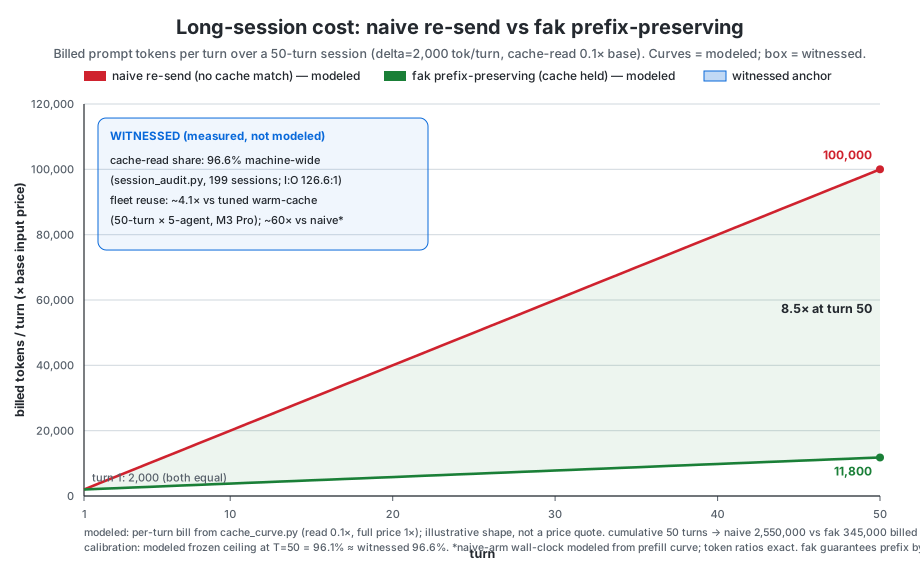
The shape of the worked example above, plotted across a 50-turn session. The two
lines are the modeled per-turn bill from
cache_curve.py (cache-read at 0.1× base, full price
1×); the box marks the witnessed anchors — the 96.6% machine-wide cache-read share
and the ~4.1× vs a *tuned warm-cache fleet result. The naive line is what happens
when the prefix match breaks (a summarize, or a cold provider cache): it pays full
price for the whole growing transcript every turn. fak keeps the shallow line by
splicing on the original bytes so the prefix stays byte-identical — it guarantees the
prefix that makes the discount possible, not the discount itself.*
The witnessed version of this at fleet scale: on a 50-turn × 5-agent run
(Qwen2.5-1.5B, Apple M3 Pro), reuse did ~60.3× less work than the naive re-send loop
and ~4.1× less than a tuned warm-cache stack — the honest, few-fold headline, not
the naive multiplier alone. The naive arm’s ~19 hours is modeled from the prefill cost
curve (validated within ~0.4%), not run live; the artifact and its fences are in
BENCHMARK-AUTHORITY.md.
What it actually saved: the production ledger
The worked example above is illustrative arithmetic, and the fleet result beneath it is a
lab benchmark. Here is the third kind of evidence — what the mechanism did in
production, folded from the real per-session cache-value ledger
(docs/nightrun/cache-savings.jsonl) and printed by fak cachevalue report.
Over 2026-07-01 to 2026-07-09 (8.33 days, 2,004 finished sessions), the ledger records $8,558 of API cost avoided against a no-cache counterfactual of $10,926 — a 78.3% net reduction — while shedding 97.1M context tokens. That number is not one blended cache claim. It is two labelled tracks kept side by side, exactly as the honest boundary above requires:
| Track | Owner | Evidence | Cost avoided (8.33d) | What it is |
|---|---|---|---|---|
| Provider prompt cache | provider (Anthropic / OpenAI) | OBSERVED — provider-relayed | $7,706 | the provider’s own cache_read discount; fak keeps the prefix byte-identical so it stays warm, but the discount is the provider’s to give |
| fak compaction shed | fak |
WITNESSED — fak-authored | $852 | the 97.1M context tokens fak dropped while holding the prefix intact, priced at the base input rate |
fak’s own authored slice is the smaller one: 9.4% of the token-equivalent saved is
fak-authored, and the rest is provider prompt-cache economics that fak preserves
rather than creates. That split is the honesty, not a footnote to it — fak reports the
provider’s number as the provider’s, and claims only the tokens it actually shed.
Two fences travel with the figure. It is a dated snapshot of a growing ledger, so run
fak cachevalue report --since 2026-07-01 for the current fold rather than trusting a
number frozen in a doc. And 23 rows are dollar-blind — a provider with no base price
configured — so their tokens are counted in the token-equivalent total but contribute
$0 to the dollar figure. The dollar number is therefore a floor: understated by the
unpriced rows, never inflated by a rate fak does not have.
The one line to keep
A long session is expensive because it re-sends everything, and the prompt cache is the
only real relief — but the cache pays out only while the prefix is byte-identical.
fak protects that byte-identity by splicing on original bytes instead of rewriting the
prompt, guarantees the byte-identical prefix, and relays the provider’s own reuse number
rather than claiming a saving it cannot force.
See also
- Addressable KV cache — what “prefix-addressed” means, and the one thing
fakdoes that shipped engines don’t. - Long sessions: shed history, keep the cache hit — the practical
fak manageflag and its break-even rule. - The frozen-trajectory cache cliff — why a long trajectory’s cache-hit rate rises by construction, and why that is not the same as getting cheaper.
- O(1) context-window economics — the accounting model underneath the per-turn cost.
Last updated: 2026-07-09