The Tool Call Is a Syscall
TL;DR: an operating system never asks a program to promise it will behave — every dangerous action must cross into the kernel, where the program has no vote.
fakputs the same boundary under an AI agent: every tool call is checked by code the model cannot talk to, talk past, or turn off. The model proposes; the kernel disposes.
Start with the computer you already trust
Your laptop runs programs you have never read, written by people you have never met. That is fine, and the reason it is fine is fifty years old.
A program can compute whatever it likes in its own memory. But the moment it wants to touch the world — write a file, open a network connection, kill a process — it cannot just do it. It has to ask. That ask is called a syscall (system call): the program stops, control crosses into the kernel — the operating system’s core, which the program does not control — and the kernel decides whether this program, with these permissions, may do this thing. The program’s opinion of its own request carries no weight. A program that says it is deleting a temp file but asks to erase your home directory gets judged on the ask, not the story.
That one design choice is why you can run untrusted code at all. Safety does not come from reading the program’s mind. It comes from a boundary the program cannot cross by being persuasive.
Now replace “program” with “model”
A large language model is a text engine: on its own it can only say things. The moment it is given tools — run a shell command, edit a file, call an API, send money — it can do things, and it becomes exactly what a program is to an operating system: useful, capable, and not to be taken at its word. It can be wrong. It can be tricked by text it read on the way (a prompt injection — instructions smuggled into a web page or file the model was merely supposed to summarize). Its stated intentions are part of its output, and its output is the thing in question.
Most agent stacks still execute the model’s tool calls on trust, or guard them with another model asked “does this look safe?” — a judge that can itself be argued with.
fak applies the fifty-year-old answer instead. A tool call — the structured
“run this tool with these arguments” message the model emits — is treated as a
syscall: it must cross a boundary into a small kernel the model does not control,
and nothing happens until that kernel rules on it.
The path of one call: proposed → verdict → (maybe) executed
fak is one Go binary that sits between the agent and the world (fak manage --
claude puts it there in one command). Every tool call walks this path:
- The model proposes. It emits a tool call — a request, not an action.
- The call crosses the boundary. It lands in the kernel’s adjudicator, in-process — no second service, no network hop. The measured cost is ~362 ns per decision (Apple M3 Pro): the check is free at the timescale of any real tool.
- The kernel rules against a capability floor. The floor is a reviewable
allow-list that is default-deny: a tool or action not explicitly granted cannot
run — no matter what the model says, or what an attacker convinced it to say. The
verdict is one of a closed set — allowed, denied, repaired (rewritten
to a safe form), or deferred (held for a human). Every refusal carries a
machine-checkable reason code (
DEFAULT_DENY,POLICY_BLOCK,SECRET_EXFIL, …), not prose. - Only an allowed call executes. And what comes back is judged too: a suspicious tool result can be quarantined — held out of the model’s context — so poisoned output never becomes the model’s next instructions.
At exit you get the ledger, one line:
fak manage: 131 kernel decisions; 121 allowed / 5 denied / 2 repaired / 0 quarantined / 3 deferred.
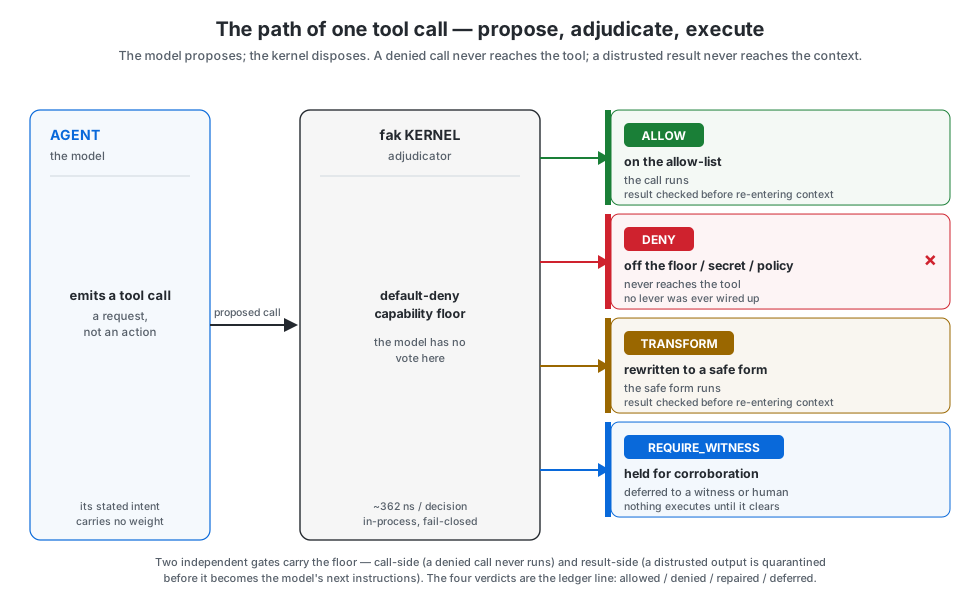
The whole path on one frame. The model only proposes; the kernel disposes — a call the floor denies never reaches the tool runner (call-side gate), and a result the floor distrusts is quarantined before it can become the model’s next instructions (result-side gate). The four verdicts on the right are exactly the four numbers in the ledger line above: allowed / denied / repaired / deferred.
REQUIRE_WITNESS can be implemented as a durable pause: persist the exact call,
release the live model/worker, verify an independently bound attestation, recheck policy,
execute once, and resume the parked turn. It does not require keeping a context window
resident in RAM. The full state machine, plugin seams, and user-preference boundaries are in
REQUIRE_WITNESS as a durable tool-call continuation.
To see the flow in motion, watch the
44-second agent-kernel explainer.
Why the placement is the whole point
Notice what this does not rely on: recognizing attacks. fak’s own injection
detector is measured ≈100% evadable by a determined attacker, and the docs say so
— every detector is. The floor holds anyway, because refusing a dangerous action does
not require catching the trick; the lever was never wired up. An OS kernel does not
detect malware to stop a permission violation, and neither does this. The deeper
engineering story — why an in-process, fail-closed check beats an external hook or an
LLM judge that fails open — is in
Policy in the kernel. None of this is a new invention;
it is the oldest idea in operating systems, finally applied to the newest kind of
program.
Try it in ten seconds
No key, no model, no GPU — ask the kernel directly:
fak preflight --tool refund_payment --args "{}"
# -> DENY (DEFAULT_DENY): not on the allow-list, fail-closed
The sentence to keep
The model proposes; the kernel disposes. If you remember one thing, remember that — and when someone asks how an AI agent can be trusted with real tools, answer the way an operating system would: it isn’t trusted; it’s adjudicated.
Next: Policy in the kernel — the engineering depth · Engineering is building loops — the loop this syscall sits inside · README — the whole project in one read.