Scaling laws of agents - thesis
Date: 2026-06-19
Scope: a plain-language thesis for why agent systems stop scaling like ordinary chat or token-serving systems. This is a framing document, not a new benchmark. Measured claims are separated from frontier hypotheses.
Use with:
- README
- Performance spectrum visual
- Session value-stack deck —
SESSION-VALUE-STACK-DECK.md(private companion — not published) - Fleet value projection —
FLEET-VALUE-PROJECTION.md(private companion — not published) - Implications memo —
IMPLICATIONS-fak-agentic-os-2026-06-18.md(private companion — not published; for the permission-floor framing it leans on, see the capability floor)
0. Thesis
The scaling law of agents is not only “more tokens need more compute.”
The better first-order law is:
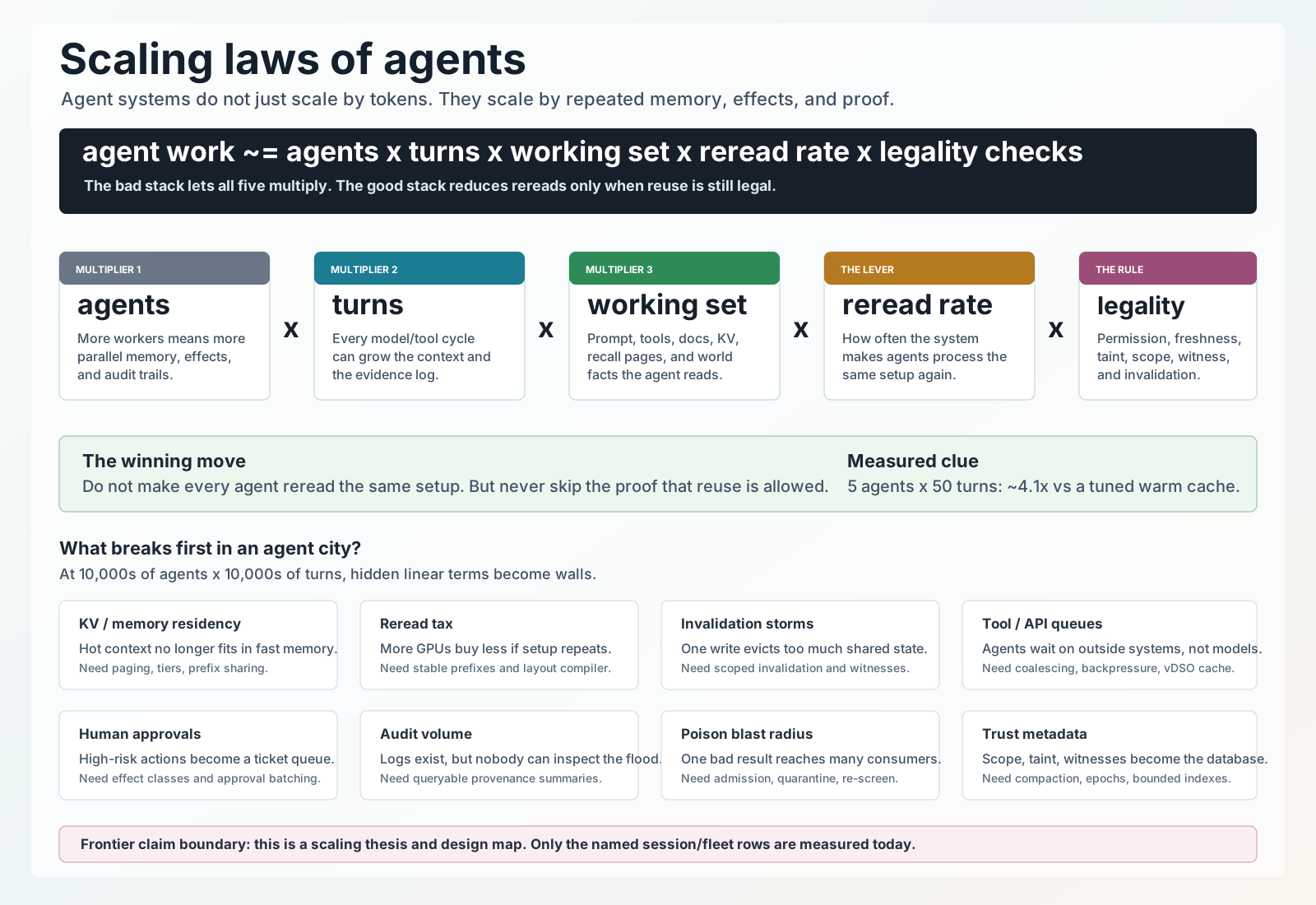
agent work ~= agents x turns x working-set size x reread rate x legality checks
Where:
- agents = how many independent workers are active;
- turns = how many model/tool cycles each worker runs;
- working-set size = shared prompt, tool schemas, recalled pages, tool results, repo/docs state, and KV spans the agent must attend to;
- reread rate = how often the system makes the model reprocess bytes it already processed;
- legality checks = permission, freshness, taint, scope, witness, and invalidation work needed before reuse is safe.
The naive agent stack lets all five multiply. A scalable stack attacks the only safe term: reread rate, but only when legality checks say reuse is still valid.
Short version:
Agents scale by deleting repeated work without deleting the proof that the work is still allowed.
1. Why agents scale differently from chat
A chat request is mostly:
prompt in -> tokens out
An agent turn is closer to:
memory view -> model proposal -> tool/effect check -> world read/write ->
result admission -> memory update -> cache/invalidation update -> audit trail
That changes the bottleneck. Raw model speed still matters, but the system also has to answer:
- may this tool call happen?
- did this result enter context or get quarantined?
- who else can reuse this result?
- what write invalidates it?
- what did the final answer depend on?
- what evidence survives if the process exits?
- can a future agent page this memory back in without laundering poison?
At small scale, these look like overhead. At frontier scale, they become the system.
2. Three regimes
| Regime | Plain description | Main bottleneck | FAK relevance |
|---|---|---|---|
| Single chat | One model call, little or no tool use. | Raw model latency and quality. | Small or no performance win; safety boundary still useful if tools exist. |
| Long agent session | One or a few agents run many turns over a stable setup. | Reprocessing the same prefix and growing transcript. | Persistent KV, prefix reuse, context admission, recall. |
| Agent city | Many agents run many turns over shared tools, memory, repos, docs, tickets, APIs, and world state. | Legal reuse, invalidation, scheduling, audit, and tool/API pressure. | Trust/coherence kernel becomes the scaling layer. |
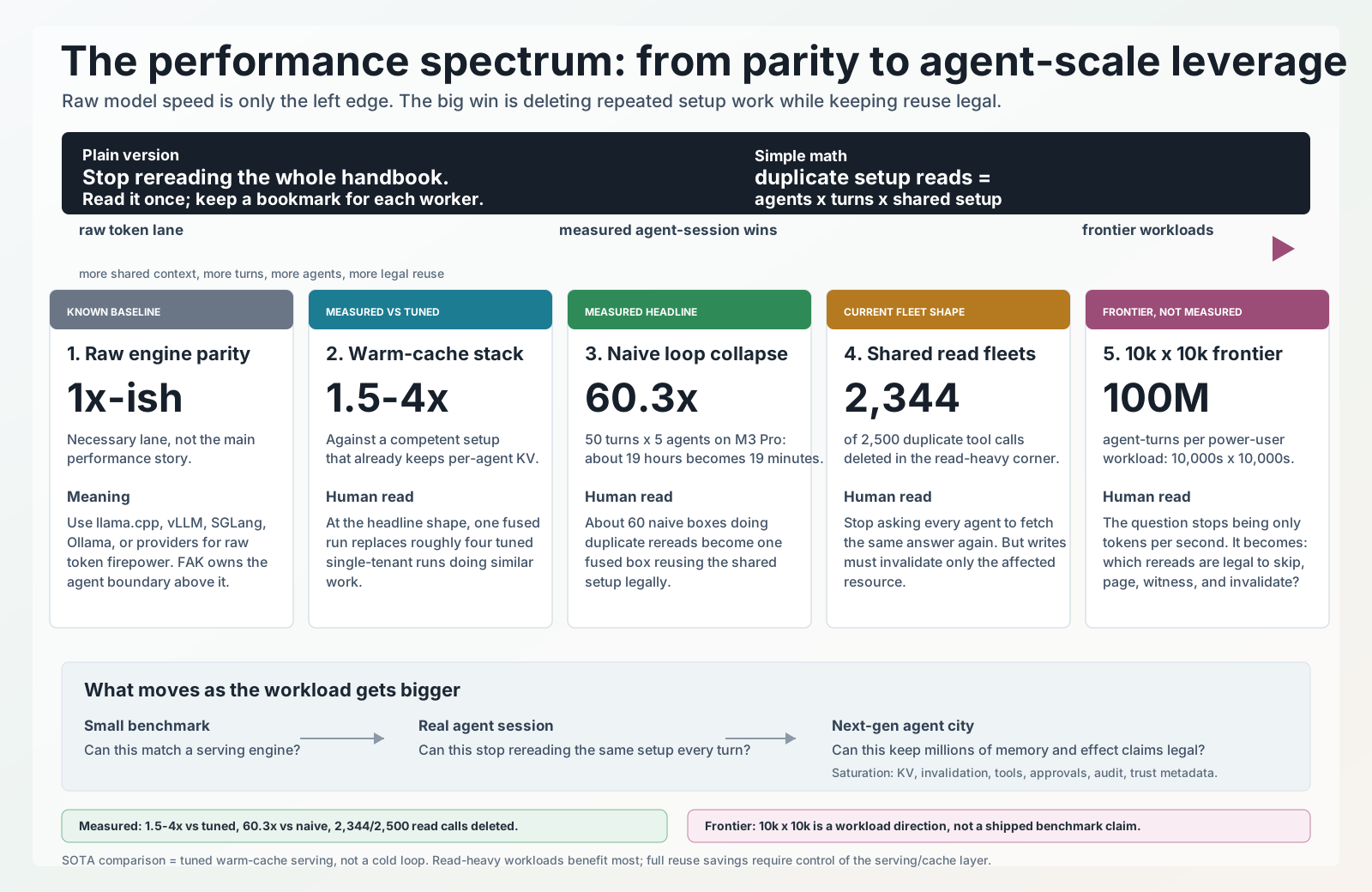
The project’s measured 50-turn x 5-agent result sits in the second regime. The 10,000 x 10,000 “agent city” is a frontier design target in the third regime, not a shipped measurement.
3. The core law: duplicate setup is the hidden tax
If every agent rereads a shared setup every turn, setup work scales like:
duplicate setup work ~= agents x turns x shared setup
That is why a 5-agent, 50-turn session already creates 250 chances to reread the same shared prompt/tool setup.
The measured session result demonstrates the shape:
- naive stateless loop: about 19 hours;
- fused reuse path: about 19 minutes;
- measured ratio: 60.3x vs the naive pattern;
- tuned comparison: about 1.5-4x, because a competent baseline already removes some duplicate rereads.
The important interpretation is not “the model got 60x faster.” It did not. The system stopped making the model reread the same shared setup.
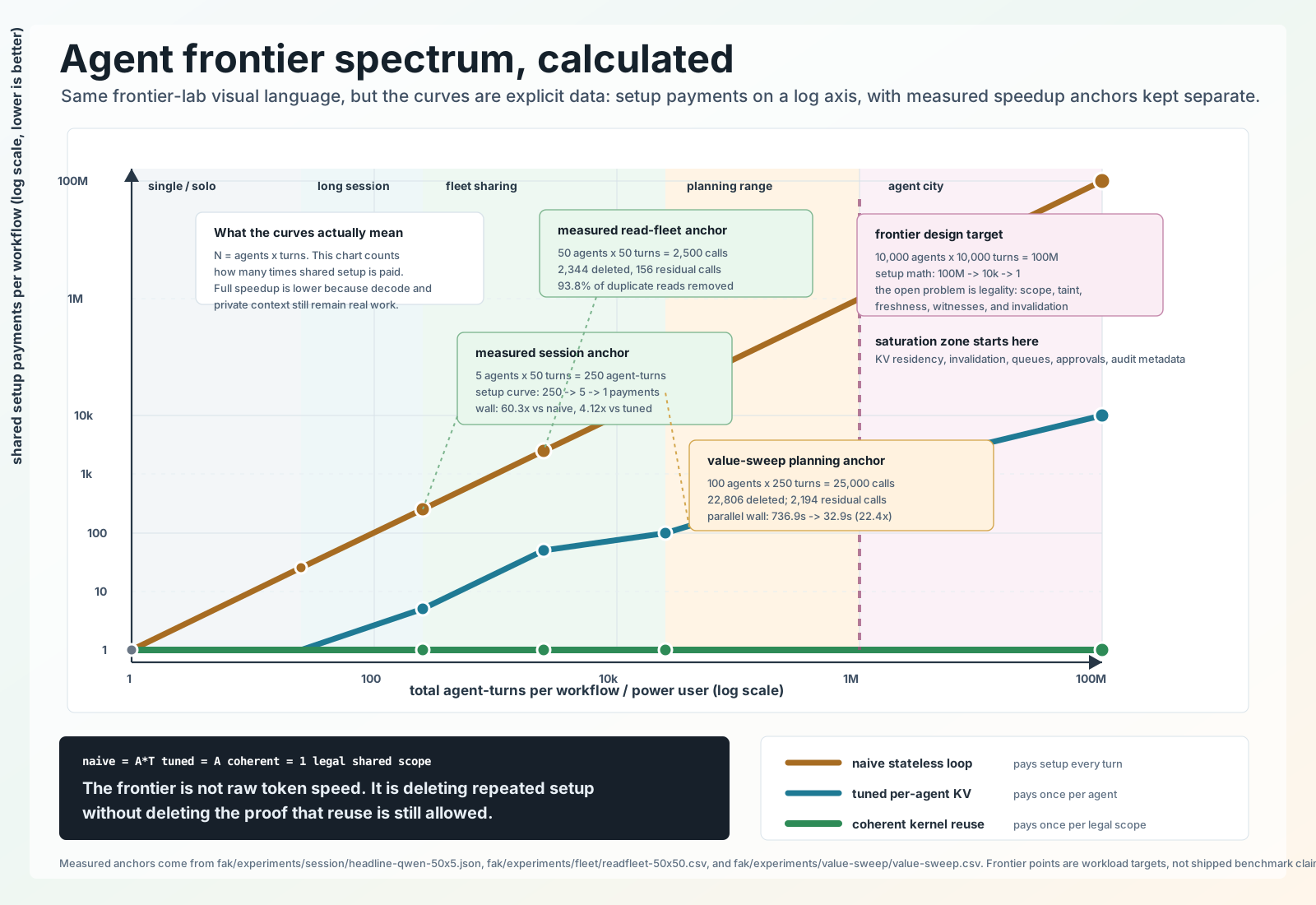
Data used for the frontier-spectrum curves
The chart’s main curves count shared setup payments, not total wall-clock. This keeps the units honest:
N = agents x turns
naive setup payments = N
tuned per-agent KV setup payments = agents
coherent shared-kernel setup payments = 1 per legal shared scope
Measured wall-clock and tool-read projections are then annotated as separate anchors:
| Workload | Agent-turns | Naive setup payments | Tuned setup payments | Coherent setup payments | Evidence anchor |
|---|---|---|---|---|---|
| 1 agent x 1 turn | 1 | 1 | 1 | 1 | Reference point. |
| 1 agent x 25 turns | 25 | 25 | 1 | 1 | Solo long session shape. |
| 5 agents x 50 turns | 250 | 250 | 5 | 1 | Measured headline: 60.3x wall vs naive, 4.12x wall vs tuned, 62.0x token floor. |
| 50 agents x 50 turns | 2,500 | 2,500 | 50 | 1 | Fleet CSV: 2,344/2,500 duplicate reads deleted; 156 residual calls. |
| 100 agents x 250 turns | 25,000 | 25,000 | 100 | 1 | Value sweep: 22,806/25,000 turns deleted; 736.9s -> 32.9s parallel wall projection. |
| 1,000 agents x 1,000 turns | 1,000,000 | 1,000,000 | 1,000 | 1 | Hypothetical frontier workload target (A·T=1,000,000), not measured. |
| 10,000 agents x 10,000 turns | 100,000,000 | 100,000,000 | 10,000 | 1 | Hypothetical frontier workload target, not measured. |
So the line shape is calculated, while the callouts say which points are measured, measured-supported projections, or future workload targets.
The exact work floor at the >100k-token regime
The setup-payment counts above are now backed by an exact, contention-free work floor at the
ultra-long-context regime this thesis is really about (per-agent context ≥ 100k tokens) — the regime
no live bench reaches, because the naive arm’s O(T²) re-prefill is intractable to run there. The
floor is closed-form arithmetic from the session shape and the model geometry (no model, no
wall-clock), with a token floor identical to sessionbench’s prefillTokens (its anchor row
reproduces the 62.0× token floor in the table above) and an O(L²)-aware FLOP floor. It quantifies
the §2 regimes directly: a single >100k session ≈ 10× vs naive · ≈ 1× vs a warm cache (the turn-tax; B/C ≡ 1, no peer to
share with), a 5-agent fleet each >100k ≈ 40×+ vs naive and ≈ 4× vs a warm cache, and it proves
the cross-agent win B/C rises monotonically with the shared-prefix fraction toward the agent
count — why the standing ~2–4× bound (small prefix) and the larger agent-city win are the same law
at different prefix fractions. See internal/turnbench/longcontext.go, cmd/longctxbench, and
docs/benchmarks/ULTRA-LONG-CONTEXT-RESULTS.md;
the levels, levers, and naming are worked out in
docs/notes/RESEARCH-ultra-long-context-levels-and-naming-2026-06-22.md.
4. The coherence law: reuse is only a win while it is legal
Shared reads create leverage. Writes create invalidation.
That gives the second law:
net reuse value ~= shared read hits - invalidation cost - stale-read risk
This is where agents differ from ordinary prompt caching. A prompt cache can ask “are these tokens the same?” An agent cache has to ask:
- same bytes?
- same model/tokenizer/position?
- same tenant/user/scope?
- same world version?
- same taint status?
- same policy?
- no later write refuted it?
- can every consumer be found if it must be revoked?
At small scale, you can dodge this with TTLs and manual cache busting. At agent-city scale, TTL-only coherence becomes guesswork. The runtime needs consumer graphs, world witnesses, scoped invalidation, and miss reasons.
Short version:
The next scaling wall is not cache existence. It is cache legality.
5. The “frontier city” saturation points
If one power user or one enterprise workflow eventually fans out to 10,000s of agents doing 10,000s of turns, the system does not break in one place. It breaks wherever a hidden linear or quadratic term was left in the loop.
| Saturation point | What breaks first | What it feels like | Needed control |
|---|---|---|---|
| KV / memory residency | Hot KV cannot all stay in HBM/DRAM. | Agents pause or recompute old context constantly. | Paging, residency tiers, prefix sharing, recompute policy. |
| Prefill / reread tax | Shared setup is reprocessed too often. | More GPUs buy less than expected. | Stable prefixes, shared KV, prompt-layout compiler. |
| Invalidation storms | One write evicts too much shared state. | Read cache flips from win to loss. | Scoped invalidation, resource-level witnesses, consumer graph. |
| Tool/API rate limits | External systems cannot serve every agent read/write. | Agents wait on APIs, not models. | vDSO/read cache, request coalescing, backpressure, leases. |
| Scheduler queues | Model capacity is idle while agents wait on tools, or tools are idle while decode dominates. | Low utilization despite high spend. | Blocked-time-aware scheduler and tier routing. |
| Human approval queues | High-risk actions all require people. | The agent city becomes a ticket queue. | Effect classes, approval batching, policy that removes unnecessary approvals. |
| Audit/log volume | Every action is logged, but nobody can inspect the flood. | Compliance data becomes dark data. | Summaries with raw evidence, retention tiers, queryable provenance. |
| Policy surface area | Tool-name allow-lists are too coarse. | Safe tools become unsafe on specific objects/accounts/amounts. | Argument/object capabilities and reviewable manifests. |
| Trust metadata size | Taint/scope/witness/consumer metadata grows with reuse. | The cache index becomes the new database. | Compaction, epochs, aggregated witnesses, bounded consumer graphs. |
| Poison propagation | One admitted bad result is reused by many agents. | A small miss becomes a fleet incident. | Result admission, quarantine, re-screen on page-in, blast-radius report. |
| World-state drift | Cached facts age out faster than agents notice. | Agents act on stale inventory, tickets, files, or deploy state. | External witnesses: git SHA, etag, lease, row version, approval id. |
| Cost observability | Token cost, tool cost, cache cost, and retry cost are split across systems. | Nobody knows why the agent city is expensive. | Per-task cost ledger and miss reasons. |
These are not all model problems. Many are operating-system, database, queueing, and governance problems.
6. Worked examples: when is a cache hot, and does that even buy you anything?
The single most expensive confusion in this whole area is that the word cache names at least seven different things, and “the cache is hot” can be true in one sense while being useless — or actively dangerous — in another. This section pins the vocabulary down, then walks three situations where the value and the bottleneck are unambiguous once you have.
6.1 Two axes, seven caches
Every “cache” in an agent serving stack lives on one of two axes:
- Physical residency — where do these bytes sit, and how fast can the compute reach them? This is the hardware memory hierarchy. It is managed automatically, it is byte-identical wherever a copy lands, and it is addressed by physical location. The hardware keeps it byte-identical (a CPU keeps its per-core caches coherent via MESI; a GPU’s L2 is one cache physically shared across all SMs, so a single copy serves every SM) with no idea what the bytes mean.
- Logical reuse — may these two requests share the same computed state, and is that still legal? This is keyed by content and identity: the token sequence, plus tenant, world-version, taint, and consumer set. Nothing in the hardware enforces it.
| “cache” | axis | lives in | addressed by | kept coherent by |
|---|---|---|---|---|
| CPU L1 / L2 / L3 (SRAM) | physical residency | the CPU die | physical line | hardware (MESI) — bytes only |
| GPU registers / shared memory (“L1”) | physical residency | each SM, on-chip | scratch, per launch | the kernel, per launch |
| GPU L2 | physical residency | the GPU die | physical line | hardware (one cache, all SMs) — bytes only |
| GPU HBM | physical residency | the GPU board | device address | the allocator |
| KV cache (the K/V tensors) | physical residency (application state) | HBM | the engine’s sequence slot | the serving engine |
| prefix cache / RadixAttention / prompt cache | logical reuse | over the KV in HBM | the token sequence | a prefix-match index |
| fak vDSO/CAS + coherence kernel | logical reuse + legality | over CAS + the KV arena | digest + scope + world-version + taint | the coherence kernel |
The top five rows are residency — where the bytes sit (the KV cache is application-managed state, but it still just lives in HBM). The bottom two are logical reuse over that state. A win on the residency axis tells you nothing about the reuse axis, and the reuse axis is the one no hardware tier answers for you. The one-line test for the cut:
“Is the cache hot” is a residency question the hardware answers for free. “Is this the same cell my trajectory may legally reuse” is a legality question only the kernel can answer. Hot-and-legal is a win; hot-and-illegal is a bug; cold-but-legal is just a recompute.
6.2 Where the KV cache actually lives (so “hot in L1/L2” is the wrong picture)
A fact that disposes of a common mental model. Take the repo’s bench-class
accelerator, a datacenter GPU: on-chip SRAM (the shared-memory / L1 pool) is ~192 KB
per SM; L2 is 40 MB shared across all SMs; HBM is 40 GB at roughly
1.5 TB/s. Now size one ultra-long-context KV cache. For a Qwen2.5-7B geometry
(28 layers, 4 KV heads under GQA, head-dim 128, fp16), each token costs
2 × 28 × 4 × 128 × 2 B = 57,344 B ≈ 56 KB of KV, so a single 100k-token context
is ≈ 5.7 GB (5.3 GiB). Read the ratios off that (illustrative arithmetic, not a fak
measurement):
one 100k KV cache             ≈ 5.7 GB
  / GPU L2 (40 MB)            ≈ 143×       too big to live in L2
  / one SM's SRAM (192 KB)    ≈ 30,000×    never a candidate for "L1"
  vs HBM (40 GB)              fits once; five of them (~28 GB) crowd it
So at the regime this thesis is about, the KV cache is never “hot in L1/L2” in the hardware sense. It is ~100× too large for L2 and not in the same order of magnitude as an SM’s SRAM. It lives in HBM and is streamed. The only thing transiently hot in SRAM is the attention kernel’s working tile — a small block of queries against a block of keys, the thing FlashAttention keeps on-chip so it never materializes the full scores matrix in HBM. That tile is ephemeral and per-launch; it is not the KV being “cached.”
This matters because decode is memory-bandwidth-bound: to produce one token you stream the whole KV cache (and the weights) out of HBM. The binding resource is HBM bandwidth and HBM capacity, not L1/L2 hit rate. Batched decode amortizes the weight stream across lanes — the bandwidth win the ultra-long-context floor deliberately excludes so it never double-counts — but it does not amortize the KV: each agent’s KV is its own.
There is a second place the hierarchy does bite, and it is easy to conflate with the first: fak’s control plane — the adjudication fold, the radix prefix-match, the CAS digest lookup — is ordinary CPU code, and there L1/L2/L3 residency is exactly what makes a decide cost 362 ns (measured, M3 Pro). The clean split:
- control plane (decide legality): CPU-bound, microseconds, does live in CPU L1/L2/L3;
- data plane (hold and attend the KV): GPU/HBM-bound, milliseconds, never in L1/L2.
A physically hot byte in the data plane is worthless if the control plane rules it illegal; a legal-but-cold lookup is a cheap recompute. The two axes again.
6.3 Scenario A — hot, resident, and still useless: divergent trajectories
This is the situation the bottleneck names directly. Five agents share a 100k-token
prefix (a repo snapshot plus fat tool schemas). The kernel prefills it once and
clones it bit-identically into all five (model.NewBatchFromPrefix, proven
max|Δ|=0). Right after prefill that prefix’s KV is resident in HBM and its tiles
stream through SRAM on every attention step. By every hardware meter it is maximally
hot.
Then the agents diverge. Agent A greps file X and ingests the result; agent B reads file Y. Their contexts are now the same prefix with different suffixes. Two things happen, and keeping them apart is the whole point:
- The shared prefix stays legally reusable. A radix prefix-tree branches at the
divergence point; the common prefix is one set of KV pages all five attend. That is
the
(N−1)·Pprefill the kernel never redoes — for five agents on a 100k prefix,4 × 100k = 400kprefill tokens eliminated. Exact geometry, not modeled. - The reusable fraction collapses to exactly the shared prefix. If you keyed reuse on “the agent’s whole context,” every agent now misses against every other — even though agent A’s context bytes are sitting hot in HBM — because the logical address (the token sequence) diverged. Hot bytes, wrong key.
The honest accounting of what reuse is left is the monotone law from the work floor:
B/C = [C·prefixWork + sharedWork] / [prefixWork + sharedWork]
It rises from 1 (no shared prefix, nothing to share, the lone-agent case) toward the agent count C (the prefix dominates). At a small 2k prefix it is ~1.3–1.5×; at a 100k shared prefix with 40 agents it climbs to 8.4× (FLOP) / 14.9× (token). Same formula, different prefix fraction. The single-agent case proves it from the other side: one agent at 100k gets ~10× vs the naive re-prefill loop, ≈ 1× vs a warm cache (B/C ≡ 1.0) — there is no peer to share with, so the entire win is not re-reading its own context each turn, and zero of it is cross-agent.
Short version: “hot” is necessary but not sufficient. The bytes being resident buys nothing unless a sibling shares the same legal prefix. The value is the shared-prefix fraction; the bottleneck is how fast the trajectories diverge away from it.
6.4 Scenario B — hot, byte-coherent, and illegal: physical coherence is not semantic coherence
Now the dangerous version. Agent A’s tool result — a git status, an inventory row,
an API response — is admitted, and its KV span is hot in HBM, byte-for-byte resident,
and (across the GPU’s shared L2, or across CPU cores for the control-plane copy)
perfectly coherent in the hardware sense: every unit that reads those bytes reads
the same bytes.
Then the world moves. Someone pushes a commit; the inventory row is updated; a different tenant’s request lands on the same shared-prefix slot. Nothing about the bytes changed, so the hardware is still perfectly happy. MESI guarantees every core sees identical bytes; the GPU L2 serves the same line. But the meaning went stale:
- reuse it for the next turn → you serve a stale fact (a correctness failure);
- reuse it across the tenant boundary → you leak (a security failure).
This is the cache-legality wall of §4 made physical. Hardware coherence keeps the
bytes identical; it has no concept that a git push invalidated the cached git
status. That semantic invalidation is exactly the work the hardware cannot do and a
prefix-match index does not do either — it is the coherence kernel’s job. fak keys
reuse on (digest, scope, world-version, taint), and on an external write it evicts
exactly the dependent span: the causal-invalidation witness shows one read evicted,
the sibling under an un-refuted witness staying byte-identical across the write
(max|Δ|=0), and a re-fill under the refuted witness refused — a targeted
eviction, not a flush. The eviction is bit-exact because the kernel owns the arena and
kept the pre-RoPE key (KVCache.Evict), so “forget this span” is byte-identical to
never having seen it.
Short version: a cache hit that passes every hardware coherence check can still be the wrong answer. Bytes-coherent is not meaning-coherent. The hardware secures the first; only the kernel can secure the second.
6.5 Scenario C — when the hierarchy limit really binds: residency, not FLOPs
Climb to the agent city. Thousands of agents, each past 100k tokens. One 100k KV cache is ~5.7 GB; a thousand of them is ~5.7 TB — orders of magnitude past HBM (tens of GB), and not in the same universe as L2 (tens of MB). At this scale the binding constraint stops being compute and becomes residency: which agents’ KV is in HBM right now, which is paged out to host DRAM (over a tens-of-GB/s PCIe link, more than an order of magnitude slower than HBM), and which must be recomputed from scratch.
“Just keep it in cache” is a category error here, because the KV was never a candidate for L1/L2 and cannot all stay in HBM either. The real levers are the L3 ones the companion levels note names: residency tiers (HBM → host DRAM → recompute), scoped invalidation so one write does not blast every sharer’s warmed KV, and legal, bit-exact eviction so demoting or dropping a span is provably safe. This is why §5’s first saturation row is “KV / memory residency,” not “FLOPs”: at city scale you run out of places to keep hot state long before you run out of arithmetic.
6.6 How the three interlock
Put the three together and the division of labor is clean:
| Concern | Sense of “cache” | Who owns it | Failure if you get it wrong |
|---|---|---|---|
| Is the prefix prefilled once and shared? | logical reuse (prefix / radix) | the serving engine + NewBatchFromPrefix |
you pay N× the prefill (the duplicate-setup tax, §3) |
| Are the bytes resident where compute can reach them? | physical residency (HBM / L2 / SRAM) | the allocator + residency tiers | you stall on paging / recompute (the residency law, §7) |
| Is this span still legal to reuse for this trajectory? | legality (scope / world / taint) | the coherence kernel | you serve stale or leak across tenants (the coherence law, §4) |
A naive stack collapses all three into “the cache is warm” and is wrong in three ways at once: it re-pays the prefix because it has no shared-prefix reuse, it thrashes HBM because it has no residency policy, and it serves stale-or-leaked state because it has no legality check. The multi-agent prefix win, the memory-hierarchy limit, and the kernel are not competing concerns. They are the three questions you must answer in order, and only the third is the one no serving engine answers for you.
Honest fences, so nothing here reads out of scope:
- The hardware figures (datacenter GPU ~192 KB SRAM / 40 MB L2 / 40 GB HBM; the ~56 KB/token KV) are illustrative geometry to make the ratios concrete — public spec and arithmetic, not a fak measurement.
- The
(N−1)·Pprefill saving and theB/Cmonotone law are exact, contention-free work numbers (the ultra-long-context floor), not a wall-clock; the live wall-clock at >100k is separately gated. A/Cis vs the naive re-prefill reference (a worst case nobody ships);B/Cis vs a tuned warm per-agent KV cache (the real serving baseline). They are never conflated.- The decode-batching bandwidth win is excluded from these reread-only numbers on
purpose; adding it back is what makes the live
sessionbenchB/Clarger than the floor’s.
7. Scaling law table
| Law | Formula-shaped intuition | Practical read |
|---|---|---|
| Turn law | work grows with turns, and naive prefill can grow faster than linear as context grows |
Long sessions punish stateless loops. |
| Fan-out law | duplicated setup grows with agents x shared setup |
More agents amplify shared-prefix wins. |
| Coherence law | reuse value falls when writes invalidate too broadly | Read-heavy wins; write-heavy needs scoped invalidation. |
| Residency law | active KV grows with agents x context |
Memory tiers matter before FLOPs are exhausted. |
| Tool-wait law | wall time includes model time plus external IO wait | Scheduler must route around blocked agents. |
| Approval law | human approvals grow with risky effects, not tokens | Policy design determines whether humans become the bottleneck. |
| Audit law | evidence volume grows with effects and reuse | Logs must become queryable provenance, not infinite transcripts. |
| Trust law | metadata grows with every shared result and consumer | The coherence graph becomes a first-class data structure. |
The naive way scales the bad terms. The kernel way tries to turn them into bounded, queryable, revocable state.
8. What should be measured next
The frontier-city thesis becomes credible only when each saturation point has a meter.
Suggested metrics:
- reread rate: what fraction of input tokens were repeated setup?
- legal cache-hit rate: cache hits that passed scope/freshness/taint checks;
- stale-prevention count: hits refused because a witness was refuted;
- invalidation blast radius: consumers evicted per write;
- KV residency pressure: bytes in HBM/DRAM/disk/recompute by agent state;
- blocked-time mix: model time vs tool wait vs approval wait;
- approval queue depth: pending high-risk actions by effect class;
- audit compression ratio: raw event bytes to queryable incident summary;
- poison blast radius: number of consumers a quarantined/refuted result would have reached;
- cost per resolved task: tokens + tool calls + retries + cache misses.
If a system cannot emit these, it cannot honestly claim to scale an agent city.
9. What FAK should claim
Say:
fakis testing the layer where agent scaling becomes a trust/coherence problem.- The measured session result shows repeated setup work can dominate practical wall time.
- The read-heavy fleet results show reuse has value, and write invalidation can erase that value if it is too broad.
- The frontier-city concept is a design target for what needs to be measured and controlled next.
Do not say:
- 10,000 x 10,000 is measured.
- 60x is raw model throughput.
- Every workload gets the 60x result.
- SOTA means a weak baseline.
- Cache reuse is safe because the bytes match.
10. Robustness: does the thesis survive a change in workload shape?
A fair objection: what if agent harnesses change the workload so the duplicate-setup
tax disappears on its own — for example by batching tool calls (one turn emitting
many tool calls at once, already shipping in major APIs)? Would that not delete the very
tax fak attacks?
It is worth taking seriously. But it relocates the work; it does not remove it.
- Batching tool calls reduces branch points (fewer separate sub-agent contexts to fork) but fattens the shared context (many tool results concatenated into one growing turn). The pressure moves from “many forked prefixes” to “one large working set with removable spans.” The control that matters shifts from prefix-sharing to scoped admission and removal of tool-result spans — still a coherence-kernel job, not a free win.
- It does not flatten recursive fan-out. A sub-agent can itself fan out; a flat batch of tool calls cannot. The agent-city regime (§2) is hierarchical, and hierarchy does not collapse into one wide turn.
Where the objection is correct: for flat, short, shallow sessions — few turns, small results, no real fan-out — there is little duplicate-setup tax to attack, and ordinary prefix caching already captures most of the win. That is the same honest boundary as the single-chat row in §2: the kernel earns its keep in the long-session and agent-city regimes, not the flat one.
Short version:
Changing how agents call tools moves where the reread and coherence tax lands. It does not change whether a coherence layer has to account for it.
This is also why the §8 meters matter. If the workload shape shifts, the reread-rate and residency meters show the tax moving (e.g. from forked-prefix payments to working-set growth) before it surprises anyone — the thesis is falsifiable, not assumed.
11. The near-term window: scaling under hardware scarcity
The laws above are structural, but their near-term weight depends on one external fact: for roughly the next two years, frontier agent deployment is hardware-constrained, not hardware-abundant.
That scarcity sharpens the first-order law rather than softening it:
- When accelerators and HBM are the binding constraint, deleting reread work converts directly into served capacity — every reread removed is a turn you did not have to buy silicon for. The reread-rate and residency wins (§3, §5) are most valuable precisely when supply is tight.
- It also front-loads the residency law (§7): hot KV that cannot all fit in HBM forces paging and recompute today, not at some hypothetical frontier.
So the thesis is naturally time-phased:
| Horizon | What pays off first | Why |
|---|---|---|
| Near term (hardware-scarce) | reread-rate deletion, prefix/KV residency, scheduling around tool-wait | scarcity turns every deleted reread into a capacity gain |
| Long term | the legality/coherence layer: legal reuse, scoped invalidation, admission, replayable evidence | it is a correctness capability, not an efficiency constant, so it outlives cheaper hardware |
The efficiency wins are what make the case now; the coherence layer is what the case
rests on after hardware stops being the bottleneck. Both terms are in the same first
law — reread rate bounded by legality checks — just weighted differently as supply
loosens.
12. One-page version
The scaling law of agents is agents x turns x working set x reread rate, bounded by legality. Raw token speed matters, but the first catastrophic waste is making every agent reread the same setup and re-fetch the same world facts. The first catastrophic correctness failure is reusing a fact after the caller, scope, witness, taint, or world state changed. At frontier scale, the product is not just a faster model server. It is an agent coherence kernel: permissions for effects, admission for memory writes, legal cache reuse, scoped invalidation, residency management, and replayable evidence.
That is the thesis.