Cache savings in one session: what fak did, and what it didn’t
2026-06-29 — a read of the fak manage exit summary for resumed session c6723f7c.
The guard printed a big number on the way out:
fak manage: cache saving — saved ~25.5M input-token-equiv across 122 turn(s)
           (NET of the write premium, 86% of the uncached cost)
It is a real saving and it is honestly labelled, but it is easy to read it as “fak saved 25.5M tokens.” It didn’t. Anthropic’s prompt cache saved them; fak measured and priced the saving. This note ablates the session three ways so the attribution is clear, then shows the small set of things fak actually changed.
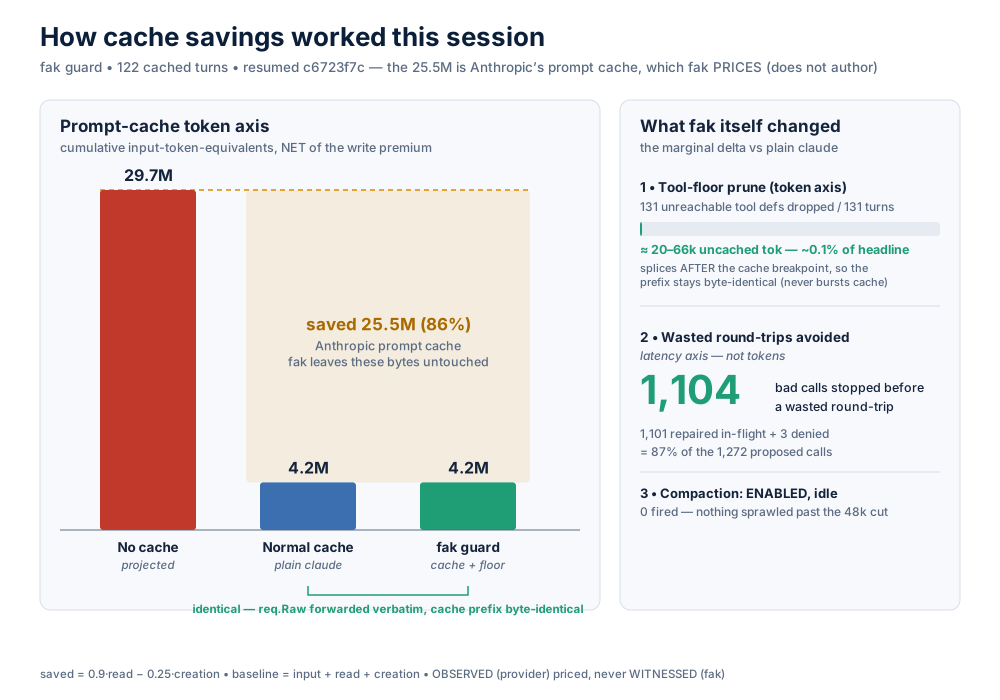
The three-way ablation
| Scenario | Prompt-cache cost (input-token-equiv) | vs no cache |
|---|---|---|
| No cache — projected, every prompt token billed cold at 1× | ~29.65M | baseline |
Normal cache — plain claude, Anthropic prompt cache on |
~4.15M | −86% |
| fak manage — the same cache, plus fak’s floor | ~4.15M on the token axis | −86%, identical + 1,104 round-trips saved |
The first two columns are the whole story on the token axis. fak’s column is the interesting one because it is the same as the column to its left — by design.
ASCII, for a terminal:
No cache    (projected)  ████████████████████████████████  29.65M
Normal cache (claude)    ████▌                              4.15M   ── 86% saved
fak manage   (cache+floor)████▌                              4.15M   ── identical
                              └─ req.Raw forwarded verbatim, prefix byte-identical
Where the 25.5M actually comes from
The number is computed in internal/gateway/cache_pricing.go
(via vcachegov.ProveTelemetrySavings) from three counters the upstream reports on
every turn:
saved    = 0.9·cache_read  −  0.25·cache_creation      (read rebate − write premium)
baseline = input + cache_read + cache_creation          (the uncached counterfactual)
savedPct = saved / baseline = 0.86   (printed)
Working backwards from the two printed figures:
baseline = 25.5M / 0.86 ≈ 29.65M— what the prompt would have cost with no cache.actual = baseline − saved ≈ 4.15M— what it actually cost.
A cache read is billed at 0.1× and a 5-minute cache write at 1.25× of the base
input price. The session is heavily read-dominated: if cache-creation is small,
cache_read ≈ 28.3M, meaning roughly 96% of all prompt tokens across the 122 turns
were served from the warm prefix instead of re-billed. That is what a long,
stable-context agent session looks like when the cache works.
The split of cache_read vs cache_creation is not recoverable from the summary
line alone; it lives on /metrics (fak_vcache_saved_token_equiv and the raw
cache_read_input_tokens / cache_creation_input_tokens). The two printed numbers
pin baseline and actual, which is what the ablation needs.
OBSERVED, not WITNESSED
This is the load-bearing distinction. The token counts are OBSERVED — relayed
verbatim from Anthropic. fak prices them with the published multipliers and reports
the dollars/tokens as cost evidence, never as a fak trust claim. The provenance
comment in cache_pricing.go is explicit: “fak relays the provider’s token counts;
it does not author them.” So “fak saved 25.5M” is the wrong sentence. The right one
is “the provider cache saved 25.5M; fak made it legible.”
Why “normal cache” and “fak manage” are identical on the token axis
fak manage -- claude runs in passthrough: it forwards req.Raw byte-for-byte to
the real Anthropic API (internal/gateway/messages.go:512). The client’s
cache_control breakpoint — and every byte before it — is unchanged through the
kernel hop. So the prefix the provider hashes for its cache is identical to what
plain claude would send, and the cache read/write the provider performs is exactly
the same. fak cannot, and does not, move the 25.5M. Remove fak entirely and the
cache saving is the same. (This is the same passthrough fact that keeps outbound
context rewrites inert on the live route today.)
What fak itself changed this session
Three levers, none of which touch the headline number:
-
Tool-floor prune (token axis, real but small). fak dropped 131 unreachable tool definitions from
tools[]across 131 turns — tools the floor wouldDEFAULT_DENYanyway, so removing the advertisement never shrinks the reachable action set. The pruner splices after the cache breakpoint and re-proves the protected prefix is byte-identical, so it never bursts the cache. This saves uncached tokens: order ~tens of thousands total (≈ 20–66k depending on def size), which is ~0.1% of the 25.5M headline. It is the only fak token saving the summary lets us see fire, and it is a rounding error next to the provider cache. (fak ships more outbound reducers — see the enablement audit below — but they emit no exit-summary line.) -
Floor effect (latency axis — the real win). fak stopped 1,104 bad tool calls before they cost a wasted round-trip: 1,101 repaired in-flight and 3 denied outright. That is 87% of the 1,272 proposed calls. This saves round-trips and wall-clock, not prompt-cache tokens — a different axis from the chart’s left panel, and the place fak earned its keep this session. (Three calls were also blocked on policy:
POLICY_BLOCK×1,SELF_MODIFY×2.) -
Compaction (idle, correctly). Enabled with a 48k budget, it fired 0 times (136 bailed, almost all
under_budget). Compaction only sheds tokens when context sprawls past the cut; nothing did, so it shed 0. “0 fired” here means working and idle, not disabled.
Plus the audit journal: 171 hash-chained rows appended (3,195 total). Observability, not savings.
The honest one-liner
The provider’s prompt cache did ~99.9% of the visible token saving and would have done it without fak. fak’s contribution this session was to price that saving honestly, trim a sliver of uncached tool-def tokens, and — its real job — catch 1,104 bad tool calls before they wasted a round-trip.
Does this mean fak’s features aren’t turned on? (enablement audit, verified at HEAD)
No. The natural follow-up to “fak didn’t move the 25.5M” is “so are its features
off?” They are not. Re-derived from the entrypoint source (cmd/fak/token_defaults.go,
which locks the defaults against regression), all six token-savers are default-on
on the fak manage -- claude route:

| Lever | Default | Operates on | This session | Why it’s quiet here |
|---|---|---|---|---|
| Provider prompt cache | ON (structural) | provider prefix | the 25.5M | Anthropic’s; fak keeps it byte-identical |
| Tool-floor prune | ON (structural) | req.Raw |
fired 131× | ~0.1% of headline |
| History compaction | ON (48k) | req.Raw |
idle, shed 0 | uncached tail never passed budget |
| Result elision | ON (16k, since 06-26) | req.Raw |
unmeasured | no exit-summary line |
| ctxview planned view | ON (8k, since 06-28, #927) | req.Raw |
unmeasured | stubs elided middle turns; cached prefix intact |
| vDSO dedup | ON | tool-side | N/A on proxy | in-kernel amplification axis doesn’t apply here |
| Adjudication floor | ON | every call | 1,104 fixed | the real work |
| Audit journal | ON | observe | 171 rows | tamper-evident, not a saver |
| In-kernel KV / paged-KV / evict | N/A | fak’s own engine | not in path | only when fak serves the model |
Two honest caveats this audit surfaces:
-
My earlier “fak’s only token saving is the tool-prune sliver” was the summary’s-eye view, not the whole truth.
ctxview(the ctxplan O(1) planned view, #927/#555) and oversized-resultelision are also default-on, also rewritereq.Raw, and also cut uncached tokens (ctxview even stubs elided middle turns while keeping the cached prefix byte-identical). Neither prints an exit-summary line, so their effect this session is unmeasured from the summary alone — it lives only on/metrics. They flipped default-on on 2026-06-28 and 2026-06-26, days before this session; a binary built earlier had them off. (This corrects the older note that outbound rewrites were dead on passthrough — #555 was closed by #927.) -
Why all these on-by-default reducers still find little to do here is structural, not a misconfiguration. Claude Code places its cache breakpoint near the end of the request, so the cached prefix is almost the entire prompt. fak deliberately refuses to rewrite that prefix — doing so would burst Anthropic’s cache and cost more — so every fak byte-lever is confined to the small uncached tail. The provider cache already captured the big win; fak stays out of its way. That is the design (a disinterested referee), not a dark switch.
If you want fak to reclaim more on this route, the knob is to tighten the budgets, e.g.
fak manage --compact-history-budget 8000 -- claude (vs the ~48k default), at the cost of
a larger blast radius on the uncached tail. The defaults are deliberately conservative.
Reproduce / verify
# the tamper-evident decision trail behind the summary
fak audit verify "$APPDATA/fak/guard-audit.jsonl"

# the same saved-token-equiv engine, offline, over telemetry
fak vcache observe   # → fak_vcache_saved_token_equiv, matches the live gateway

# raw provider counters live on the gateway
curl -s localhost:<port>/metrics | grep -E 'cache_read|cache_creation|saved_token_equiv'

# which token-savers are actually default-on (re-derived from the entrypoint source)
fak token-defaults-scorecard          # all six locked on; ctxview/elide effect on /metrics
See also
internal/gateway/cache_pricing.go— the pricing model and its OBSERVED-vs-WITNESSED provenance.internal/vcachegov/proof.go—ProveTelemetrySavings, the engine shared by the live summary andfak vcache observe.- O(1)-context-window economics — the broader cost model this sits inside.